
Updated October 4, 2026.
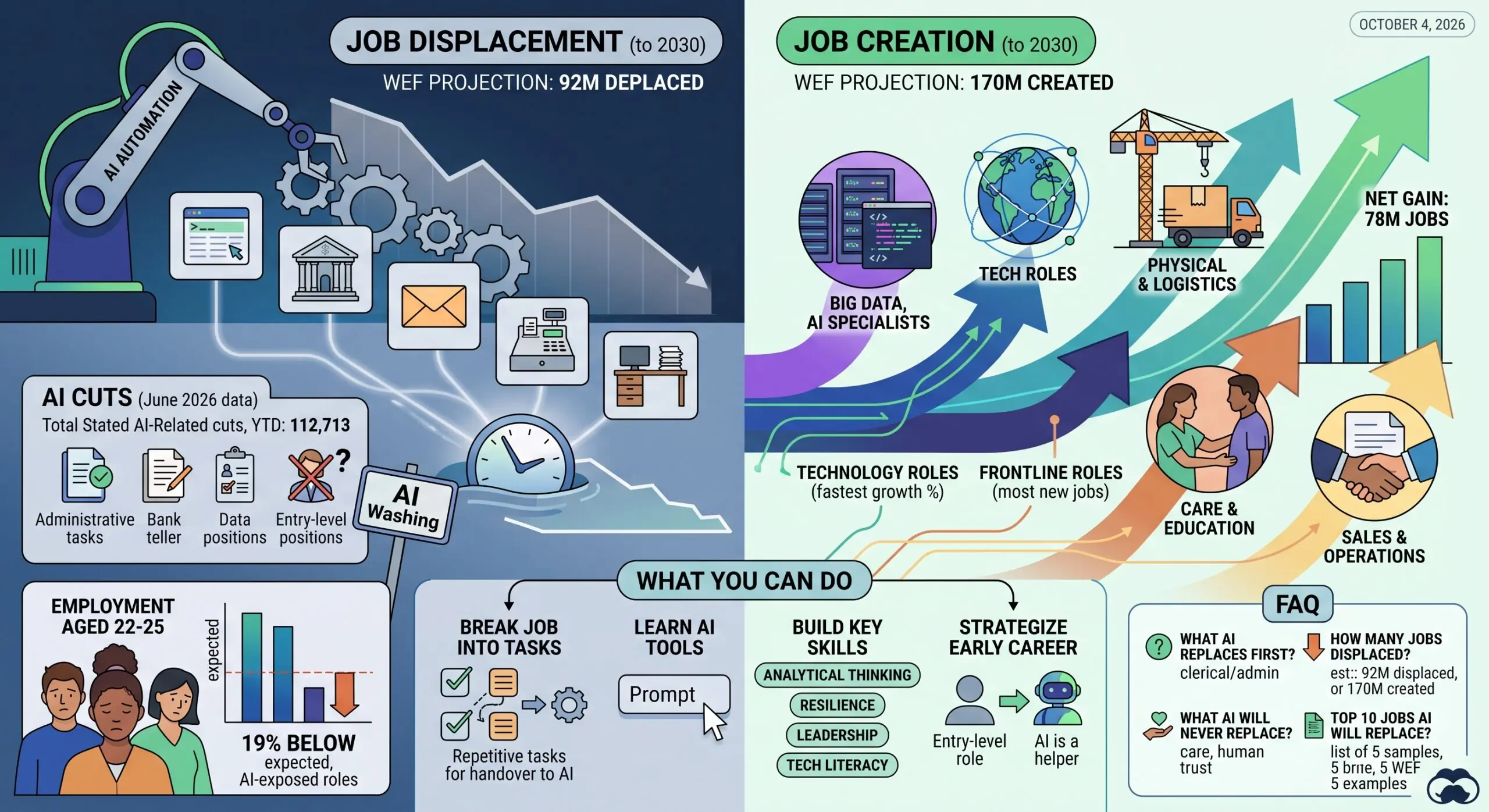
The jobs AI will replace by 2030 are not whole professions. The data does not show entire careers disappearing overnight. It shows specific tasks, mostly clerical, administrative and entry-level, being automated, and hiring slowing in the most exposed roles. The World Economic Forum projects that 92 million jobs will be displaced by 2030 while 170 million are created, a net gain of 78 million. But a revised Stanford study using payroll data through June 2026 finds that employment of workers aged 22 to 25 in AI-exposed occupations is now 19% below where it would be otherwise.
Here is what the major sources say about the jobs AI will replace by 2030, which roles sit on each side of the line, and what you can do about it.
Jobs AI will replace by 2030: what the WEF forecast says
Table of Contents
The Future of Jobs Report 2025 surveyed more than 1,000 employers representing over 14 million workers. Its headline numbers:
- 22% of today’s jobs will be created or destroyed by structural change by 2030.
- 170 million new jobs (14% of current employment) against 92 million displaced (8%), for a net gain of 78 million.
- 40% of employers expect to reduce their workforce where AI can automate tasks, while two-thirds plan to hire people with specific AI skills.
- 39% of workers’ current skills are expected to be transformed or become outdated.
Note that these are employer expectations, not measurements. They are a map of where pressure is expected, not a guarantee.
What is happening right now
Forecasts aside, two 2026 data sets show which jobs AI will replace by 2030 are already under pressure today.
Layoff announcements. Challenger, Gray & Christmas tracks the reasons employers give for job cuts. Its June report showed AI cited in 101,743 announced cuts so far in 2026, about 23% of all cuts. The July report had AI as the leading reason for the month, at 10,970 cuts, and a year-to-date total of 112,713. Coverage of the August report said restructuring replaced AI as the top reason that month, so the trend is not a straight line. Challenger counts stated reasons, and Forrester has warned of “AI washing”: companies blaming AI for cuts that were driven by finances.
Who is actually affected. The Stanford payroll study found no evidence of widespread, economy-wide job displacement. It did find that young workers in AI-exposed occupations are the ones falling behind, mainly because companies are hiring fewer of them, not firing more. In occupations where AI mostly complements workers, employment is flat or rising, especially for experienced workers. The authors call these early indicators, not proof of cause.
Jobs most exposed to AI by 2030
| Role | Why it is exposed | What the WEF says |
|---|---|---|
| Data entry clerks | Repetitive, rules-based work | Among the fastest-declining roles |
| Bank tellers | Routine transactions moving to apps and automation | Among the fastest-declining roles |
| Postal service clerks | Declining volume plus automation | Among the fastest-declining roles |
| Cashiers and ticket clerks | Self-service and automated checkout | Largest decline in absolute numbers |
| Administrative assistants and executive secretaries | Scheduling, drafting and filing can be automated | Largest decline in absolute numbers |
Jobs growing, and why
- Technology roles grow fastest in percentage terms: big data specialists, fintech engineers, AI and machine learning specialists, software developers.
- Frontline roles add the most jobs in raw numbers: farmworkers, delivery drivers, construction workers, salespeople and food processing workers.
- Care and education roles also grow: nursing professionals, social work and counselling, personal care aides, and teachers.
Our reading of this list: jobs that depend on physical presence, trust or in-person care are harder to automate than jobs that process information on a screen. That is an inference from the data, not a promise.
How to read any list of jobs AI will replace by 2030
Most viral lists share the same three weaknesses, and knowing them is the fastest way to judge whether a prediction deserves your attention.
- A forecast is not a measurement. The WEF numbers come from employers describing what they expect to do, collected before most of them had deployed the tools at scale.
- A job is a bundle of tasks. Automation usually removes some tasks and leaves others, which changes a role rather than deleting it. A bookkeeper whose data entry disappears may spend more time on review and client advice.
- Stated reasons can be strategic. As the Forrester warning above suggests, naming AI in a layoff announcement can sound better to investors than admitting weak demand.
So treat any ranking of the jobs AI will replace by 2030 as a map of pressure, not a schedule. The useful question is not whether your job title appears on a list, but which of your weekly tasks a tool could already do.
What to do about it
- Break your job into tasks. List what you do in a week and mark which tasks are repetitive and rule-based. Those are the ones to hand to AI first.
- Learn the tools that touch your tasks. Start with writing better instructions; our guide to writing ChatGPT prompts is a practical first step.
- Build the skills employers say they need. The WEF ranks analytical thinking as the most sought-after core skill, followed by resilience and flexibility, then leadership. AI and big data, networks and cybersecurity, and technology literacy are the fastest-growing skills. See our look at AI phishing detection tools for what security work involves.
- If you are early in your career, aim for roles where AI is a helper, such as analysis, sales, operations or care, and keep a portfolio of real work. The Stanford findings suggest the entry-level door is narrowing fastest.
You can also build toward the opposite side of the ledger; see our guide to the AI skills to learn in 2026. If you are curious about who is funding this shift, read our roundup of AI startups to watch in 2026.
Frequently Asked Questions
What jobs will AI replace first?
The earliest and clearest pressure is on routine clerical and administrative work, such as data entry, bank teller tasks, cashier roles and basic scheduling, and on entry-level positions in AI-exposed fields. Recent data shows the effect is showing up as slower hiring of young workers rather than mass firing.
How many jobs AI will replace by 2030?
The World Economic Forum estimates 92 million jobs displaced by 2030, offset by 170 million created, for a net gain of 78 million. That covers all structural change, not AI alone. Treat any single number as an estimate.
What jobs will AI never replace?
No job is guaranteed safe, but roles built around physical presence, human care and trust, such as nursing, social work, teaching and skilled trades, are growing in the WEF data. Within almost any job, the parts that involve judgment, negotiation and relationships are the hardest to hand off.
What are the top 10 jobs AI will replace by 2030?
There is no reliable official top-10 ranking of the jobs AI will replace by 2030. The WEF names data entry clerks, bank tellers, postal service clerks, cashiers and ticket clerks, administrative assistants and executive secretaries as the roles expected to shrink most. Be cautious of lists that claim a precise ranking without a source.