
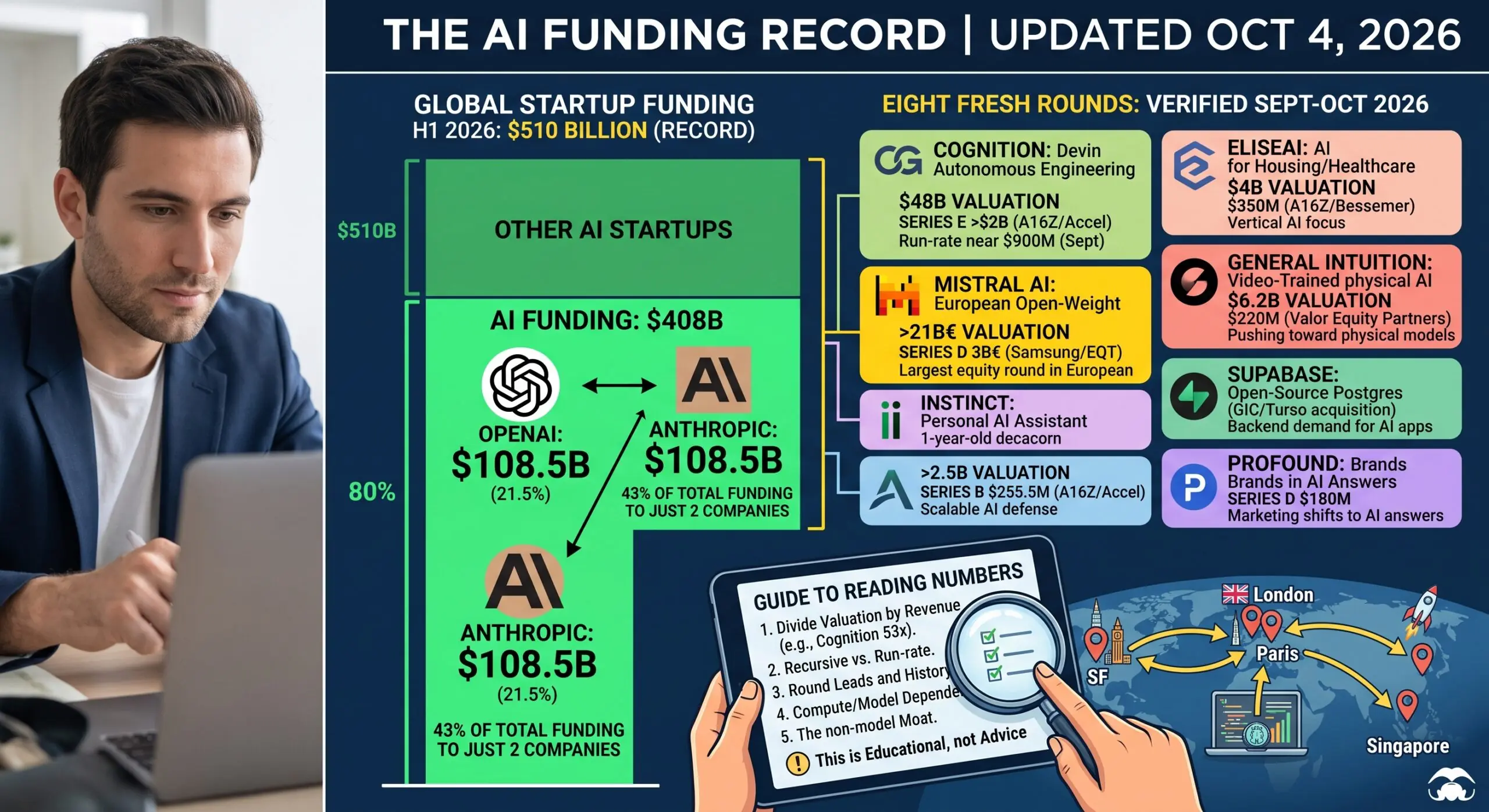

Startups raised a record $510 billion worldwide in the first half of 2026, according to Crunchbase’s half-year report, and OpenAI and Anthropic alone took $217 billion of it, or 43%. The more useful question for most readers is who else is raising big money. Below are eight AI startups with fresh, verified rounds, followed by a plain-English guide to reading the numbers.
The funding picture in four numbers
Table of Contents
- $510 billion in global startup funding in H1 2026, a record that beats the previous half-year high of $375 billion in the second half of 2021.
- $305 billion in Q1 and $205 billion in Q2. AI took roughly 80% of Q1 capital and more than 70% of Q2.
- 43% of all H1 funding went to just two companies, OpenAI and Anthropic.
- About 88% of AI startup funding had gone to US companies as of a mid-June Crunchbase analysis.
When two companies take that much, averages mislead. Everyone else, AI or not, is competing for a smaller pool.
Eight AI startups to watch
| Startup | What it builds | Latest round | Why it matters |
|---|---|---|---|
| Cognition | Devin, an autonomous software-engineering agent | Series E of over $2 billion at a $48 billion valuation, announced Sept. 8, 2026, led by Andreessen Horowitz and Accel | Says run-rate revenue grew from $492 million in May to almost $900 million |
| Mistral AI | Open-weight models, the Le Chat assistant and an enterprise platform | Series D of 3 billion euros at more than 21 billion euros post-money, Sept. 8, 2026, led by Samsung Electronics | The largest equity round in European tech history |
| Instinct | A personal AI assistant for everyday tasks | $1 billion Series C at a $10 billion valuation, backed by Sequoia, Benchmark and Coatue | A one-year-old company at a ten-figure valuation |
| Armadin | AI-native, autonomous cybersecurity | $255.5 million Series B at a valuation above $2.5 billion, led by Andreessen Horowitz and Accel | Shows investors expect AI-driven attacks and defense to scale together |
| EliseAI | AI for housing and, increasingly, healthcare | $350 million at a $4 billion valuation, led by Andreessen Horowitz and Bessemer | A vertical AI company selling into a specific industry |
| General Intuition | Models trained on video and virtual worlds to learn skills for physical environments | $220 million at a $6.2 billion valuation, led by Valor Equity Partners and Atreides | Part of the push toward physical AI and world models |
| Supabase | An open-source Postgres platform for app developers | $150 million led by GIC, plus the acquisition of Turso | Backend demand is growing as AI tools generate more apps |
| Profound | Software that shows how brands appear in AI answers | $180 million Series D at a $1.8 billion valuation | Marketing budgets are shifting from search results to AI answers |
Sources: Crunchbase’s weekly roundup for Sept. 26 to Oct. 2 (Instinct, Armadin, EliseAI, General Intuition, Supabase), Crunchbase’s roundup for Sept. 12 to 18 (Profound), Orrick’s announcement for Mistral and Latham & Watkins’ announcement for Cognition.
The three stories worth a closer look
Cognition is the clearest example of an agent business moving fast. Its valuation nearly doubled in about four months, from $26 billion in May to $48 billion in September, and the company says run-rate revenue rose by about 83% over the same period. Run-rate is an annualized snapshot of recent revenue reported by the company, not audited annual revenue.
Mistral matters because it is Europe’s answer to the US labs. Its valuation rose from about 11.7 billion euros a year earlier to more than 21 billion euros, and the round brought in Samsung, EQT’s Scaleup Europe Fund and PSG Equity.
Armadin and its peers show where security money is going. If you want the practical side of that trend, see our guide to AI phishing detection tools.
How to read an AI startup valuation
- Divide valuation by revenue. Cognition’s $48 billion against roughly $900 million of run-rate works out to about 53 times (our calculation). That is only reasonable if growth keeps compounding.
- Ask whether revenue is recurring or run-rate. Annualizing a strong month can flatter the picture.
- Look at who is leading the round. Large, repeat investors tell you something; a single new name pricing an early round tells you less.
- Check dependence on compute and on other companies’ models. Many startups build on someone else’s model, which limits pricing power.
- Look for a moat that is not the model. Distribution, proprietary data and workflow lock-in last longer than a benchmark lead.
This is educational, not investment advice. Most of these companies are private, and private rounds are generally open to institutions and accredited investors.
If you are thinking about what this boom means for your own career, read jobs AI will replace by 2030. For tools you can use today, see the best AI productivity tools for small business.
Frequently Asked Questions
How do AI startups make money?
Most charge subscriptions per user, usage-based fees for API calls, or enterprise contracts. Newer agent products are experimenting with pricing per task or per outcome. Revenue can grow quickly, but compute is expensive, so growth does not automatically mean profit.
Are AI startups profitable?
Most are not yet, and reliable data is thin because the companies are private. Many disclose growth in revenue or run-rate, but few disclose profit. Treat any claim of widespread profitability with caution unless it comes with audited figures.
Are AI startups overvalued?
It depends on whether growth continues. The bull case points to revenue rising very quickly, as at Cognition. The bear case points to valuations of 50 times run-rate or more, and to funding concentrated in a handful of companies. Both views have evidence behind them, which is why checking the revenue behind each valuation matters.
How to invest in AI startups?
Direct investment in private startups is generally limited to institutions and accredited investors. Most individuals get exposure through public companies, funds or ETFs that hold AI businesses, each with its own risks and fees. This is general information, not advice, so speak with a licensed advisor before investing.