
Updated October 4, 2026.
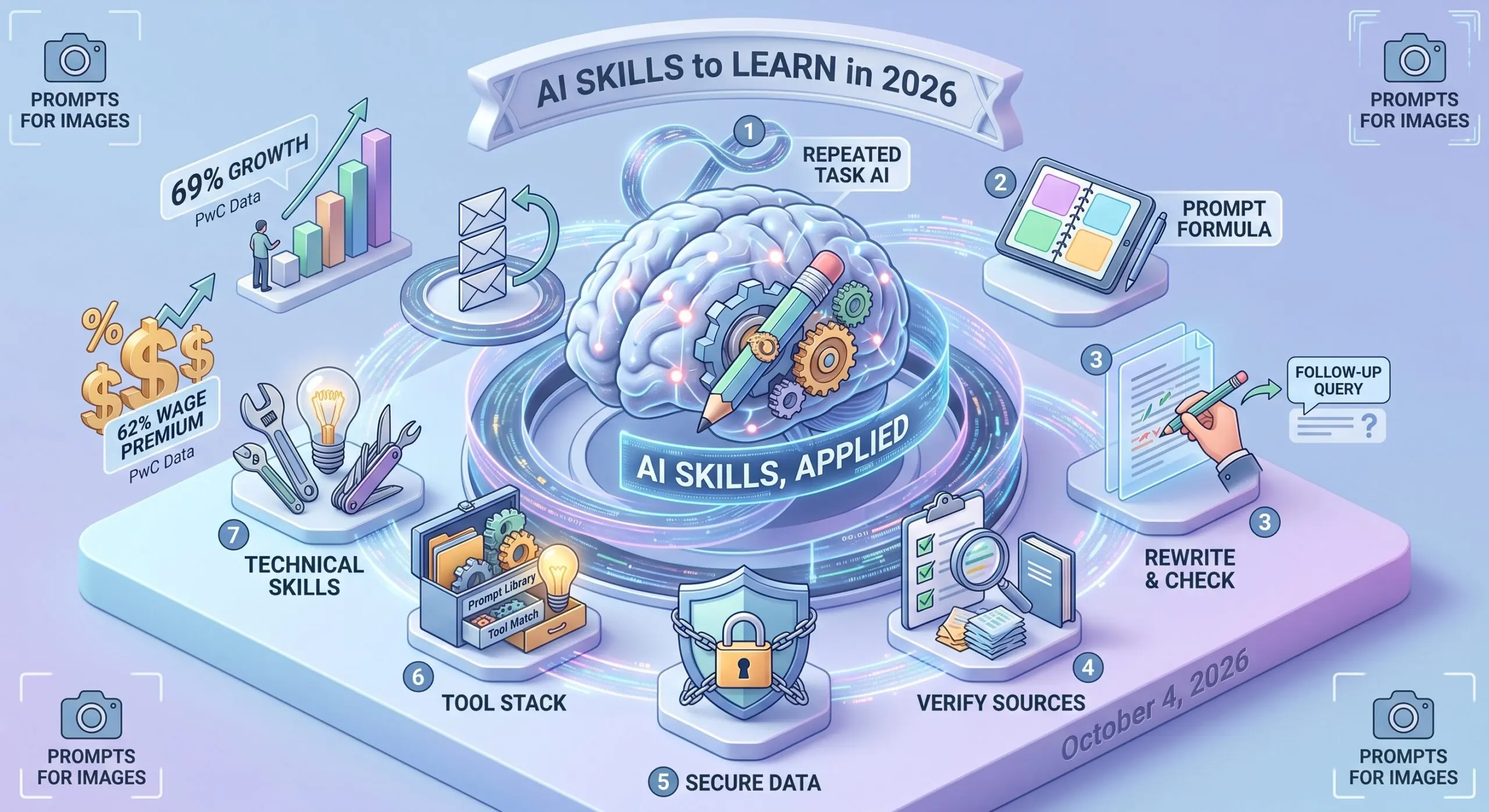
The AI skills to learn in 2026 fall into three groups: basic AI literacy that almost every job now expects, the ability to apply AI inside your own field, and technical skills for building AI systems. The data points the same way from several directions. PwC’s 2026 Global AI Jobs Barometer, which analyzed more than one billion job ads in 27 countries, found that jobs requiring AI skills grew 69% against 9% for the whole job market, and that the average wage premium for AI skills rose to 62%, up from 57% a year earlier.
This guide turns those numbers into a practical list: which skills employers are asking for, who needs each one, how to prove it, and where to start for free.
What the 2026 data says
Table of Contents
- Pay: PwC reports a 62% average wage premium for workers with AI skills, and says the number of AI jobs is almost twice what it was in 2024. See PwC’s press release.
- Demand: LinkedIn’s 2026 Skills on the Rise report put AI engineering, operational efficiency and AI business strategy at the top, and found that job postings requiring AI literacy grew by more than 70% year over year, according to coverage of the report.
- Scarcity: the same coverage cites a Robert Half survey in which AI and machine learning topped the list of hardest-to-find skills, alongside IT operations, governance and compliance, and cloud architecture.
- Human skills: PwC found AI-exposed entry-level roles are seven times more likely to ask for traditionally senior skills such as judgment, leadership and face-to-face communication.
One caution: PwC sells AI services, so it has a commercial interest in findings that frame AI as an opportunity. The premium is also an average across job ads, not a promise that a course will raise your own salary. Use the figures as a direction, not a guarantee.
AI skills to learn in 2026, by who needs them
| Skill | Who needs it | How to show it | Where to start |
|---|---|---|---|
| AI literacy: what AI can and cannot do, and its risks | Everyone | You can explain limits such as made-up facts and privacy risks, and you follow a checking habit | Elements of AI (free) |
| Prompting and checking outputs | Anyone who writes, researches or analyzes | A saved prompt library with before-and-after examples | Our guides on ChatGPT prompts and using AI tools effectively |
| Applying AI to your own workflow (AI business strategy, automation) | Managers, marketers, finance and operations staff | Two or three documented workflows with time saved and error rates | Google AI Essentials (paid after trial) |
| Data work with AI: analysis and evaluating model output | Analysts, researchers, product teams | A case study that compares AI results with a known correct answer | Practice on your own spreadsheets and public datasets |
| AI engineering: building LLM applications, retrieval, deployment | Developers and data engineers | A shipped project with a public repository | Official API documentation from the model providers |
| AI security, governance and compliance | Security, legal and risk teams | A policy you wrote, or a certification | See our guide to Microsoft AI cybersecurity tools for the certification path |
| Judgment, communication and leadership | Everyone | Examples of decisions you made with AI input and what you changed | On-the-job practice; no course replaces it |
The beginner path: AI literacy and prompting
If you are starting from zero, begin here. LinkedIn’s data suggests AI literacy is becoming a baseline requirement, not a differentiator, so treat it as the entry ticket. The goal is not to memorize jargon. It is to know how to get a useful draft, spot a wrong answer and keep sensitive data out of the chat. Elements of AI is free, needs no programming, and has had more than 2 million sign-ups. Google AI Essentials takes under five hours but costs $49 a month in the US and Canada after a seven-day trial.
The professional path: apply AI in your own field
This is where most of the money is for non-engineers. An accountant who can set up and check an AI-assisted workflow, or a marketer who can run a content process with human review, is more valuable than someone who only knows how to chat with a bot. Pick your three most time-consuming tasks, redesign each with AI, measure the time and quality before and after, and write down what you learned. That record is your proof. Our guide to AI productivity tools for small business lists tools to try.
The technical path: build with AI
LinkedIn’s report highlights prompt engineering, model training and data annotation alongside AI engineering. If you code, the practical route is to build one real application, such as a document question-answering tool, deploy it, and publish the code on GitHub with a short write-up of what it does badly. Employers read that more closely than a certificate.
A 90-day plan
- Weeks 1 to 2: complete an AI literacy course and set up your checking habits.
- Weeks 3 to 6: redesign three real tasks at work or in a side project, and keep a log of results.
- Weeks 7 to 12: turn the best result into proof: a short case study, a portfolio entry or a repository. Add it to your resume and LinkedIn profile.
If you are worried about the opposite side of the picture, read our breakdown of jobs AI will replace by 2030.
Frequently Asked Questions
What are the top AI skills to learn in 2026?
Start with AI literacy and prompting, then move to applying AI in your own field. LinkedIn’s report lists AI engineering, operational efficiency and AI business strategy as the fastest-growing skills, so those are strong next steps depending on whether your job is technical or business focused.
Which AI skills are in demand?
Employers are asking for AI literacy, prompt engineering, model training, data annotation, AI engineering and AI business strategy. Governance and compliance skills are also hard to hire for, according to Robert Half’s survey.
Can I learn AI skills without coding?
Yes. AI literacy, prompting and applying AI to your own work do not require programming. Coding matters only if you want to build AI systems rather than use them.
Do AI skills increase salary?
PwC’s 2026 analysis found an average 62% wage premium for workers with AI skills, but that is an average across job ads and reflects the roles that ask for AI skills. It does not mean any single course will raise your pay by that much. Proof of results matters more than a certificate.
How long does it take to learn AI skills?
Basic literacy can take a few hours to a few weeks. Google AI Essentials, for example, takes under five hours. Applying AI to your own work convincingly usually takes a couple of months of real practice, and technical skills take longer.
What is the list of AI skills for beginners?
Understanding what AI can and cannot do, writing clear prompts, checking answers against reliable sources, protecting private data, and using AI for one or two tasks in your daily work. The table above shows where each of these sits among the wider skill set.