
Updated October 4, 2026.
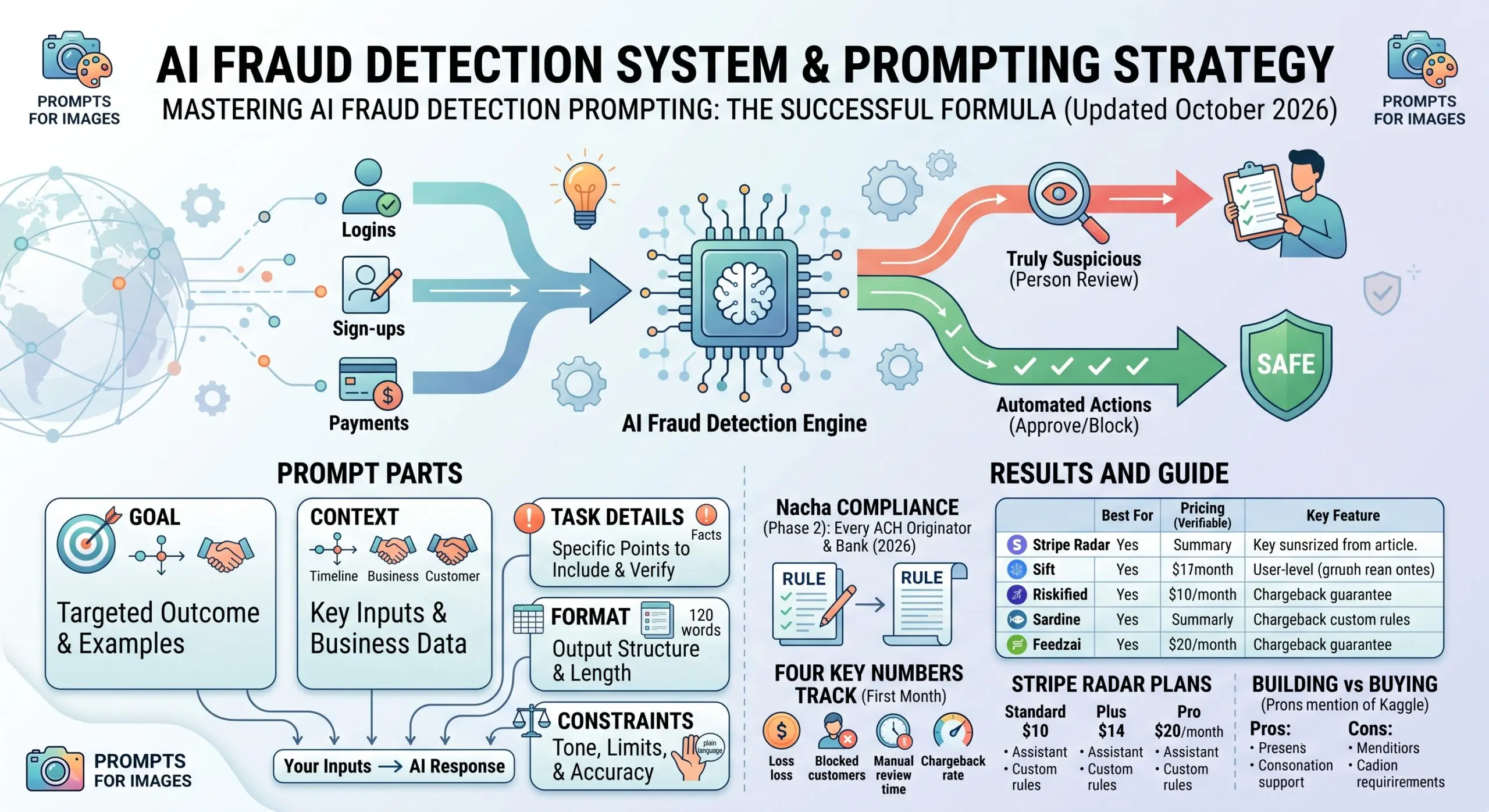
AI fraud detection tools use machine learning to score payments, sign-ups and logins for risk, so a person only has to look at the small share that is truly suspicious. For most online businesses the real choice is between a fraud layer built into your payment processor, which is cheap and quick to switch on, and a dedicated platform, which costs more and is mostly sold by quote. In the US there is also a regulatory push: Nacha’s fraud monitoring rule reached every ACH originator and receiving bank on June 22, 2026.
This guide compares the main tools, shows the pricing we could verify (only Stripe Radar publishes it clearly), and explains how to choose without overpaying.
Why fraud tools matter more in 2026
Table of Contents
The FBI’s 2025 Internet Crime Report counted 24,768 business email compromise complaints with about $3.05 billion in losses, and 22,364 complaints that mentioned AI, with roughly $893 million in losses. Much of this fraud involves no malware at all, only a convincing request to move money, which is why transaction and behavior monitoring matter.
On the compliance side, Nacha’s new rules require risk-based fraud monitoring for ACH payments. Phase 1 started on March 20, 2026 for large originators and banks. Phase 2 followed on June 22, 2026 (June 19 fell on a federal holiday) and covers all other non-consumer originators, third-party senders and every receiving bank. The rule does not name a product. It asks for a documented monitoring process, reviewed at least once a year, that is reasonably designed to catch suspicious entries, including vendor and payroll impersonation.
AI fraud detection tools compared
| Tool | Best for | Pricing we could verify | Worth knowing |
|---|---|---|---|
| Stripe Radar | Businesses that take card and wallet payments online | Standard from $10 a month, Plus from $14, Pro from $20, or pay as you go (platforms and marketplaces: $20, $44, $70) | Works across payment methods. Stripe says its AI also works for businesses that do not process payments on Stripe. |
| Sift | Digital businesses facing payment fraud, account takeover and promotion abuse | Volume-based, not published | Looks at fraud at the user level, not only the transaction |
| Riskified | E-commerce merchants who want to hand chargeback risk to the vendor | Not published | Uses a chargeback guarantee model |
| Signifyd | E-commerce merchants | Not published | Reviewers on G2 highlight its fraud prevention guarantee |
| Sardine | Fintech and crypto companies | Not published | Real-time risk decisioning; positioned for ACH fraud monitoring |
| Feedzai | Large banks and payment processors | Enterprise, custom quote | One platform for fraud, financial crime and compliance across channels |
Several vendors show “no pricing available” even on review sites such as G2, so expect a sales call for anything beyond Stripe. Prices change, so confirm before you buy.
Stripe Radar plans in plain English
Because Stripe is the only major tool here with public pricing, it is the easiest benchmark. Its pricing page describes three levels for a single business:
- Radar Standard (from $10 a month): AI-based fraud prevention across payment methods, card testing prevention, fraud alerts, analytics and default rules.
- Radar Plus (from $14 a month): adds risk scores from 0 to 99, custom rules with backtesting, manual review queues, adaptive 3D Secure, advanced analytics and the Radar Assistant.
- Radar Pro (from $20 a month): adds dynamic risk thresholds and abuse protection against free trial abuse, bots, multi-account and account sharing.
There is also Radar Lite, which Stripe includes at no extra charge for businesses on standard payments pricing. The pay-as-you-go rates only appear after you pick a plan, so we cannot quote them here. Many older guides cite per-transaction fees under the name “Radar for Fraud Teams”; the current page uses Standard, Plus and Pro, so treat older numbers with caution.
Fraud detection tools in banking
Banks and processors tend to buy enterprise platforms such as Feedzai, usually alongside tools from the card networks. What they monitor goes beyond card payments: account takeover, ACH credits, and scams in which the customer is tricked into authorizing the payment. Nacha’s 2026 rule widens that last category, because it explicitly covers credits sent under false pretenses, such as a fake vendor invoice or a redirected paycheck.
If you run a small business that sends or receives ACH payments, ask your bank what monitoring it already performs for you, and document the answer. That is usually cheaper than buying your own layer.
Building your own model from GitHub or Kaggle
Searches for credit card fraud detection code on GitHub are common, and the usual starting point is the public Credit Card Fraud Detection dataset on Kaggle. It is excellent for learning, but a model trained on it is not a production fraud system, for three reasons:
- Fraud is rare, so a model can look 99% accurate while catching almost none of it. Judge it on precision and recall instead.
- Fraudsters change tactics, so a model needs fresh labeled data from your own customers and regular retraining.
- Someone has to run manual review, handle disputes and keep the system secure and compliant.
How to choose
- Under a few thousand payments a month, on Stripe: start with Radar Standard or Plus. The cost is small and it runs without engineering work.
- E-commerce with a real chargeback problem: get quotes from Riskified and Signifyd and compare how each handles liability.
- Accounts, promotions or marketplaces under attack: a user-level tool such as Sift, or Radar Pro for abuse patterns.
- Fintech, crypto or lending: Sardine and similar platforms are built for onboarding checks and payment risk together.
- A bank or large processor: expect a multi-vendor stack and a long procurement.
This is our reading of how the products are positioned, not a head-to-head test. Whatever you pick, track four numbers from the first month: fraud losses, good customers wrongly declined, manual review hours and the chargeback rate. Related reading: our guides to AI accounting software for small business, AI phishing detection and the best AI cybersecurity software.
Frequently Asked Questions
What are AI fraud detection tools?
They are software that uses machine learning to judge whether a payment, account or login looks fraudulent. They learn patterns from past fraud and legitimate activity, give each event a risk score, and then approve, block or send it to a person for review.
How much does Stripe Radar cost?
Stripe’s pricing page lists Radar Standard from $10 a month, Plus from $14 and Pro from $20 for a single business, with a pay-as-you-go option. Platforms and marketplaces start at $20, $44 and $70 a month. Radar Lite is included for businesses on standard payments pricing.
Do banks use AI to detect fraud?
Yes. Banks widely use machine learning for transaction monitoring, and vendors such as Feedzai sell AI-based fraud platforms to them. We could not find a single authoritative adoption percentage, so we do not quote one.
Which industry uses AI for fraud detection?
Banking and payments are the largest users, followed by e-commerce, fintech, crypto and insurance. The vendor landscape reflects this: Feedzai targets banks, Riskified and Signifyd target online retailers, and Sardine targets fintech and crypto.
Which companies are the top fraud detection companies?
There is no official ranking. The names that appear most often in review-site comparisons are Feedzai, Sift, Riskified, Signifyd, Sardine and Stripe Radar. Which is best depends on your industry, volume and how much engineering time you have.
Is fraud monitoring required by law?
For ACH payments in the US, Nacha’s rules now require risk-based fraud monitoring from originators and receiving banks, with the final phase effective June 22, 2026. The rule sets an outcome rather than naming a product, so check with your bank on what it already covers.