
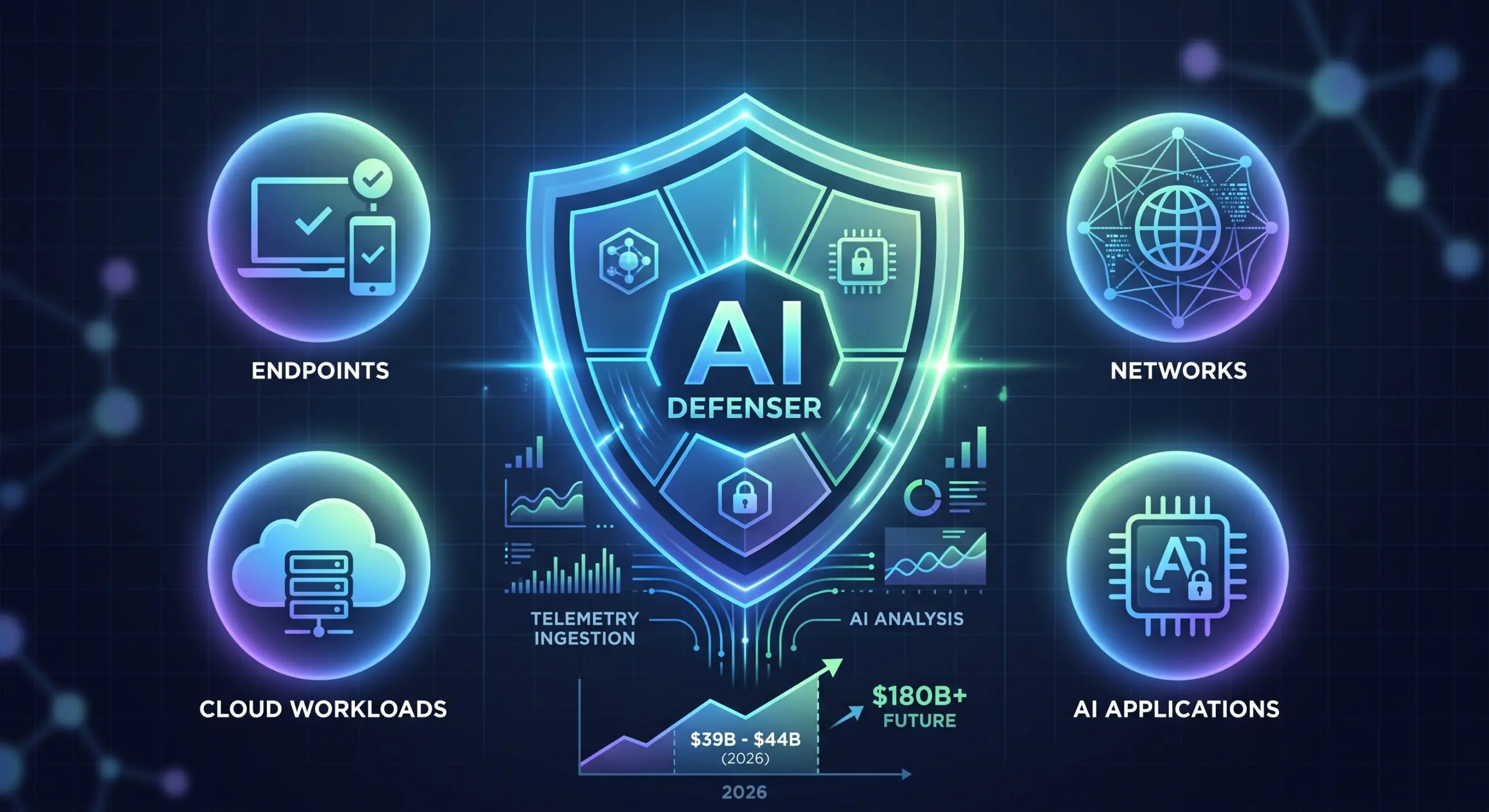
The best AI cybersecurity software in 2026 depends heavily on what you’re protecting: endpoints, networks, cloud workloads, or AI applications themselves. For most mid-size and enterprise organizations, CrowdStrike Falcon, SentinelOne Singularity, and Darktrace lead the market, while Microsoft Security Copilot is the strongest option for teams already living inside the Microsoft ecosystem. This guide breaks down pricing, strengths, and the right fit for each major tool so you can match your budget and threat model to the right platform.
The market has matured fast. The global AI cybersecurity market is already worth $39–44 billion in 2026 and is projected to exceed $180–213 billion in the coming years, as attackers and defenders both lean harder on machine learning and agentic AI. That growth has pushed vendors to ship autonomous investigation agents, natural-language threat hunting, and self-learning detection that doesn’t rely on static signatures.
What Counts as “AI Cybersecurity Software” in 2026
Table of Contents
AI cybersecurity tools now fall into a few distinct categories, and knowing which one you actually need matters more than chasing the single “best” product on a list:
- Endpoint/XDR platforms that use on-device machine learning to stop malware and ransomware (CrowdStrike, SentinelOne)
- Network and behavioral detection that learns normal traffic patterns to flag anomalies (Darktrace)
- SOC copilots that use generative AI to investigate alerts and write incident summaries in plain language (Microsoft Security Copilot)
- Application and AI-asset security that scans code, dependencies, and AI models themselves for risk (Snyk, Checkmarx, Mend)
Best AI Cybersecurity Software Compared for 2026
| Tool | Best For | Key AI Feature | Starting Price |
|---|---|---|---|
| CrowdStrike Falcon | Large enterprises wanting endpoint + XDR breadth | Charlotte AI agentic analyst | ~$59.99/device/year (Falcon Go) |
| SentinelOne Singularity | Autonomous endpoint protection on a budget | Purple AI generative security analyst | $69.99/endpoint/year (Core) |
| Darktrace | Network, cloud, and email-wide anomaly detection | Self-learning AI Analyst and Autonomous Response | Custom, generally ~$30,000+/year |
| Microsoft Security Copilot | Teams already on Microsoft 365 E5/Defender | Natural-language incident investigation | $4/SCU/hour, or included with E5 |
| Snyk | Securing AI-generated and open-source code | Agentic AI fix suggestions across the SDLC | Custom / free tier for small teams |
| Checkmarx One | Enterprise AppSec at high release velocity | AI assistance across IDE, CI/CD, governance | Custom quote |
CrowdStrike Falcon: Best for Enterprise Endpoint and XDR Coverage
CrowdStrike Falcon is a cloud-native endpoint and extended detection and response platform that has become one of the most widely deployed enterprise security suites. CrowdStrike Falcon is a cloud-native endpoint and extended detection and response platform, and one of the most widely deployed enterprise security platforms in operation, with its AI story built on two layers: the detection engine that powers endpoint protection, and Charlotte AI, the platform’s agentic analyst layer.
Falcon is a strong fit for organizations that want endpoint protection as the backbone of their security stack with agentic tooling tied directly into that telemetry. On pricing, the entry-level Falcon Go tier starts at roughly $59.99 per device per year, with Falcon Pro, Enterprise, and Elite tiers priced higher, and Charlotte AI along with modules like Identity Protection are typically sold as add-ons rather than bundled into the base price. Full enterprise contracts, once modules a serious deployment actually needs are layered in, commonly range from $50,000 to well over $1,000,000 annually depending on organization size.
Who Should Choose CrowdStrike
Choose Falcon if you need broad, published pricing tiers to start, plan to scale into a full XDR deployment, and want an agentic AI layer tightly coupled to endpoint telemetry rather than bolted on separately.
SentinelOne Singularity: Best Value for Autonomous Endpoint Defense
SentinelOne runs behavioral AI directly on the endpoint agent rather than depending entirely on cloud lookups, which means it keeps protecting devices even offline. SentinelOne Singularity is an autonomous endpoint and XDR platform built around on-agent AI that detects and remediates without waiting on cloud lookups. The company also points to strong third-party validation: it achieves 100% detection rates with zero delays in the MITRE ATT&CK Enterprise Evaluations and has maintained a multi-year streak as a Leader in the Gartner Magic Quadrant.
Pricing is published and tiered, which sets it apart from several competitors. SentinelOne pricing in 2026 lists at $69.99 per endpoint per year for Singularity Core, $79.99 for Control, and $179.99 for Complete, the tier most enterprise security teams deploy because it is the lowest level that includes full EDR. Its generative AI analyst is tied to that Complete tier: Purple AI is included starting from the Singularity Complete tier at $179.99/endpoint, and the Enterprise tier adds an Agentic AI SOC Analyst that can autonomously triage alerts without human involvement. Real-world negotiated pricing tends to run lower than list price at scale, with negotiated prices at 500–1,000 seats running $60–$75 for Complete per Vendr’s transaction benchmark data.
Who Should Choose SentinelOne
SentinelOne is a good match for budget-conscious enterprises and SMBs that want transparent, published pricing and an endpoint-first approach with a built-in generative AI analyst, without committing to custom enterprise quotes upfront.
Darktrace: Best for Network-Wide Behavioral Detection
Darktrace takes a different approach than endpoint-first vendors. Darktrace is an AI-powered cybersecurity platform that uses self-learning technology to detect and respond to threats in real time, identifying unknown and evolving attacks without relying on predefined rules or signatures, and continuously learning from network behavior to spot anomalies such as insider threats, ransomware, or data breaches instantly. Its coverage spans an Autonomous Response engine capable of real-time threat containment, an AI Analyst for automated narrative-style incident investigation, and broad coverage spanning network, cloud, and endpoint environments rather than endpoint-only.
Darktrace doesn’t publish a rate card, which makes budgeting harder upfront. Estimates vary across sources, but most agree it’s priced at the premium end: one source puts general costs starting at approximately $30,000 per year, while another notes Darktrace prices by network size rather than endpoint count, with enterprise deployments typically running $100,000–300,000+ per year depending on network complexity and coverage scope. Smaller deployments can also land higher than expected, since small deployments of 100-500 devices can run $50,000-$150,000 per year, with multi-module bundles scaling steeply.
Who Should Choose Darktrace
Darktrace fits large enterprises that need visibility across network, cloud, email, and OT environments simultaneously, and that can absorb an initial alert-tuning period. It’s frequently deployed alongside an endpoint tool like CrowdStrike or SentinelOne rather than replacing one.
Microsoft Security Copilot: Best for Microsoft-Centric SOC Teams
Microsoft Security Copilot is a generative AI assistant purpose-built for security operations rather than general productivity. It’s a generative AI security analyst built on top of Microsoft’s threat intelligence and Defender ecosystem, processing security signals from Defender, Microsoft Sentinel, Intune, and third-party sources, letting analysts investigate faster using plain language queries and AI-generated incident summaries. Teams already running Microsoft infrastructure get the most out of it since it pulls from signals already flowing through their existing Microsoft stack.
Pricing is consumption-based rather than per-seat. Standalone Security Compute Units cost $4 per hour, with a single provisioned SCU running 24/7 costing roughly $2,920 per month or $35,000 per year. The more economical path for most organizations is through an existing license: the Microsoft 365 E5 inclusion gives 400 SCUs per month for every 1,000 paid E5 licenses, up to 10,000 SCUs per month, at no additional cost. Overage usage beyond that pool bills at $6 per hour.
Who Should Choose Microsoft Security Copilot
This is the obvious pick if your organization is already on Microsoft 365 E5 and running Defender or Sentinel, since you likely get a usable SCU allocation already baked into your license. It’s a weaker standalone choice for organizations without existing Microsoft security infrastructure to feed it signal.
Application and AI-Asset Security: Snyk, Checkmarx, and Mend
As more code gets written with AI assistance, securing the code itself has become its own category. Snyk focuses on this shift directly: Snyk is an application security tool for identifying and resolving vulnerabilities within code, third-party open source components, container images, and infrastructure as code, and its AI cybersecurity tool uses agentic artificial intelligence throughout the development cycle to manage the risks associated with AI code generation, aimed at teams that ship products rapidly and need security to match their pace.
Checkmarx One targets a similar problem for larger AppSec teams, offering dual-mode AI scanning with automated remediation and dedicated AI asset governance for organizations building AI-enabled applications that need unified security across code, open source, containers, and AI assets, though higher pricing and mixed integration experiences may impact overall value in some environments. Mend covers similar ground with a supply-chain focus: the Mend AI Native Application Security Platform is designed to secure AI-driven software development from code creation to deployment, built for environments leveraging AI-generated code and models, with integrated protection across source code, open source components, containers, and AI assets.
How to Choose the Right AI Cybersecurity Software
Start with your threat surface, not the vendor logo
If most of your risk lives on laptops and servers, an endpoint-first platform like CrowdStrike or SentinelOne will deliver more immediate value than a network detection tool. If your biggest blind spot is lateral movement across a complex network with cloud, OT, and email all in play, Darktrace’s broader behavioral model fits better.
Match pricing models to your budget predictability needs
Per-endpoint pricing from CrowdStrike and SentinelOne is easier to forecast than Darktrace’s custom network-size pricing or Microsoft’s consumption-based SCU model, which can spike during heavy incident response periods.
Check what you already own
If your organization already holds Microsoft 365 E5 licenses, Security Copilot’s included SCU pool can make it functionally free to start, whereas standing up a new vendor from scratch always carries integration overhead.
Don’t skip application security
Endpoint and network tools don’t catch vulnerabilities introduced by AI-generated code or vulnerable open-source dependencies. If your teams ship software regularly, pairing an endpoint platform with an AppSec tool like Snyk or Checkmarx closes a gap that pure threat-detection platforms leave open.
Frequently Asked Questions
What is the best AI cybersecurity software for small businesses?
SentinelOne Singularity is considered excellent for SMBs due to its ease of use, lightweight agent, and affordable pricing starting at $69.99 per endpoint, providing robust endpoint protection without requiring extensive IT resources. Its published pricing also makes budgeting simpler than vendors that require a custom quote for every deployment size.
Is Darktrace or CrowdStrike better for enterprise security?
They solve different problems. CrowdStrike is endpoint-first with agentic AI tied directly to device telemetry, while Darktrace focuses on network-wide behavioral anomaly detection across cloud, email, and OT environments. Many large enterprises run both together rather than choosing one over the other.
How much does AI cybersecurity software cost per year?
It varies widely by category and company size. Endpoint platforms like CrowdStrike and SentinelOne start around $60-$70 per device annually and scale with tier and seat count, while network-wide platforms like Darktrace commonly run $100,000–300,000+ per year depending on network complexity, number of locations, and coverage scope for enterprise deployments.
Does Microsoft Security Copilot replace Defender or Sentinel?
No. Security Copilot is an AI assistant layer that sits on top of existing Microsoft security products rather than replacing them. It pulls signals from Defender, Sentinel, Intune, and Entra to help analysts investigate faster, but it requires those underlying products to already be collecting telemetry.
Are AI cybersecurity tools worth it for reducing false positives?
Vendors report meaningful reductions in analyst workload from AI-driven triage and natural-language investigation tools, though actual results depend heavily on tuning and data quality. Expect an initial adjustment period, since self-learning models can generate a high volume of alerts during the initial tuning period, typically 2-4 weeks, before they stabilize.
Can I use more than one AI cybersecurity platform at once?
Yes, and it’s common practice. Many organizations layer an endpoint platform like CrowdStrike or SentinelOne with a network detection tool like Darktrace and an application security scanner like Snyk, since each covers a different part of the attack surface rather than competing for the same job.