
Salesforce Einstein is a strong choice if you already run a Salesforce org, need AI features like lead scoring and forecasting built into records you already use, and can afford the jump to Enterprise-tier pricing or higher. This Salesforce Einstein review breaks down what you actually get for the money, which features are worth turning on, and where the platform falls short for teams that aren’t already deep in the Salesforce ecosystem.
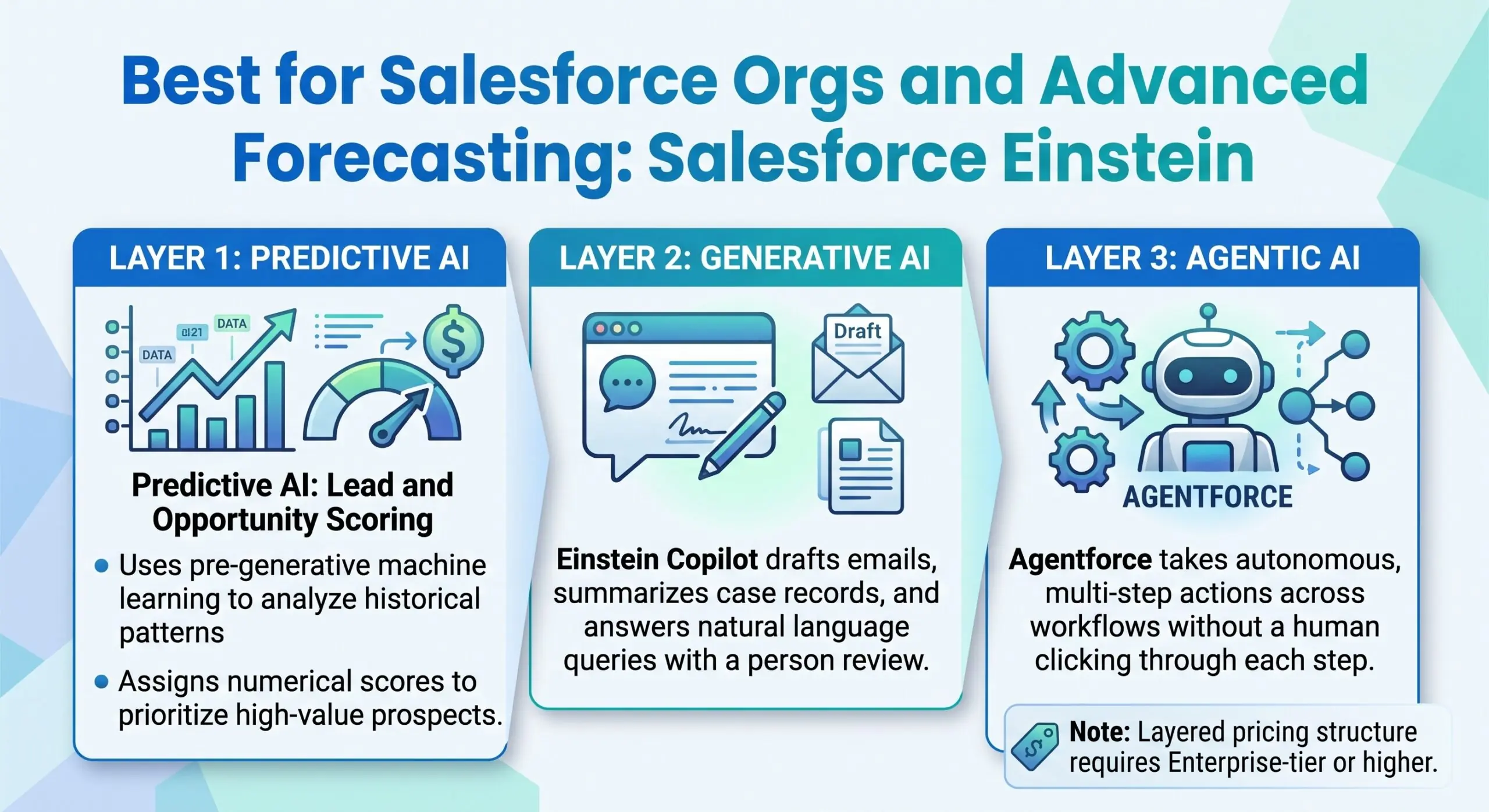
Einstein isn’t a single app you install. It is a family of AI capabilities that Salesforce has added in layers, each licensed and priced differently, as Oliv AI’s overview also lays out: predictive AI (lead and opportunity scoring), generative AI (drafting and summarizing, which began as Einstein Copilot and is now part of Agentforce), and agentic AI (Agentforce, which takes autonomous actions). That layered structure is the single biggest thing to understand before you evaluate pricing or features.
What Is Salesforce Einstein?
Table of Contents
Salesforce has used the ‘Einstein’ name for its AI layer since 2016, making it one of the oldest branded AI features in enterprise software. Salesforce launched Einstein GPT in 2023 and Agentforce in 2024, and Einstein capabilities now sit across its clouds, including Sales, Service, Marketing, Commerce, and Analytics.
The original Einstein features are classic machine learning that predates generative AI: they score leads and opportunities based on your historical data. Generative features came later, first as Einstein Copilot, which drafts emails and summarizes records with a person reviewing the output, and which Salesforce has since folded into Agentforce (it appears as ‘Agentforce (Default)’ in Setup). Agentforce itself is built to act with less hand-holding, taking actions without someone clicking through each step.
Salesforce Einstein Pricing in 2026
There is no single Einstein price tag, and that’s the most common source of confusion for buyers. Instead, AI capability is tied to which Salesforce edition or add-on you purchase.
Sales Cloud Editions With Einstein AI
AI features arrive bundled inside Sales Cloud tiers rather than as a separate purchase. Current published pricing runs Free Suite at $0, Starter Suite at $25, Pro Suite at $100, Enterprise at $175, Unlimited at $350, and Agentforce 1 Sales at $550 per user per month, with Pro Suite and above billed annually. Basic predictive features like scoring and forecasting typically run on Salesforce’s models at no incremental cost once your edition includes them.
Standalone Einstein Add-Ons
If your edition doesn’t include the AI you want, Salesforce sells it separately. Generative add-ons such as Einstein for Sales and Einstein for Service are priced per seat for capabilities like email drafting and case summarization, and listed prices for these add-ons commonly fall between $50 and $75 per user, per month on top of your base license. Confirm the current figure for the specific add-on on Salesforce’s pricing pages, since packaging changes often.
Agentforce 1 Editions and Flex Credits
For organizations that want everything bundled, Agentforce 1 Editions list from about $550 per user per month. Agentforce can also be bought on consumption: Flex Credits cost $500 per 100,000 credits, and a standard action uses 20 credits, or about $0.10. Salesforce also lists a $2 per-conversation option for some agents, but pricing guides note that Flex Credits and per-conversation billing can’t be mixed within one org. Consumption pricing makes budgeting harder for teams with variable support or sales volumes.
Watch Out for These Pricing Traps
- Org-wide licensing waste: Buying a generative add-on for every seat is expensive shelfware if only part of the team will use it, so start with the roles that will.
- Changing pricing models: Agentforce launched in 2024 at $2 per conversation, moved to Flex Credits in May 2025, and now has several models side by side, so older articles may quote figures that no longer apply.
- Stale pricing pages: List prices increased roughly 6% in August 2025, so older reviews and comparison sites still show outdated Enterprise and Unlimited numbers. Always confirm current pricing directly on Salesforce’s official Sales Cloud pricing page before budgeting.
| Plan/Add-on | Approx. Price | What You Get |
|---|---|---|
| Starter Suite | $25/user/mo | Basic CRM, no meaningful AI |
| Pro Suite | $100/user/mo | Core CRM plus limited automation |
| Enterprise | $175/user/mo | Predictive scoring, forecasting, customization |
| Unlimited | $350/user/mo | Full predictive AI features |
| Agentforce 1 Sales | $550/user/mo | Full Einstein suite plus Agentforce agents |
| Generative add-ons | $50-$75/user/mo | Email drafting, case summarization |
| Agentforce Flex Credits | $500 per 100,000 credits (about $0.10 per action) | Consumption-based agent actions; $2 per conversation also listed for some agents |
Core Salesforce Einstein Features
Predictive Lead and Opportunity Scoring
This is the oldest and most tested part of Einstein. Einstein Lead Scoring ranks prospects by how likely they are to convert, and Opportunity Insights flags risks and suggests next steps on open deals (Agent Finder’s review summarizes both). Because the system learns from your company’s own historical sales patterns, results improve as your pipeline data matures, but they depend heavily on clean, consistent records.
Einstein Forecasting
Einstein Forecasting predicts revenue based on historical patterns and current pipeline health, and shows up directly in your existing pipeline dashboards rather than in a separate tool. Unlike standalone sales AI products that need separate logins, Einstein lives inside Salesforce, so lead scores, opportunity insights, and forecasts all appear on the records your reps already open every day.
Einstein Activity Capture
Einstein Activity Capture automatically logs emails and meetings so reps don’t have to enter them by hand. It has no clear standalone price: a standard version comes with eligible Sales Cloud editions, while the fuller version ships with paid products such as Sales Cloud Einstein or Salesforce Inbox, so check what your edition includes.
Einstein Conversation Intelligence
Sales managers tend to value this one most. Conversations recorded through Salesforce’s integrated calling tools are automatically transcribed and analyzed for topics, sentiment, competitor mentions, and next steps, and the tool can flag calls where competitors came up and add them to coaching queues.
Einstein Copilot (Now Part of Agentforce)
Launched in 2024 as Einstein Copilot, this conversational assistant was renamed and folded into Agentforce in early 2025. It lets reps ask plain-English questions about their pipeline, draft emails, and summarize opportunities without leaving the CRM, making it one of the AI features reps are most likely to use day to day.
Agentforce
Agentforce is Salesforce’s autonomous agent platform, built to take actions in Salesforce without a person prompting each step. Common deployments include SDR agents that qualify inbound leads, service agents that resolve support cases, and coaching agents that give post-call feedback. It is billed by consumption (Flex Credits per action, or per conversation for some agents) or through per-user bundles, rather than as a simple per-seat add-on.
Pros and Cons
Where Einstein Delivers
- Deep native integration means AI insights appear directly on the records reps already use, with no separate app or login.
- Lead scoring and forecasting are mature, well-tested features with years of real-world tuning behind them.
- Conversation intelligence and coaching queues genuinely help sales managers spend time on the right deals.
- For large enterprise teams with clean data and dedicated admins, the AI can justify enterprise-level pricing.
Where Einstein Falls Short
- Every Einstein feature depends on clean, consistent, complete Salesforce data, and lead scoring specifically needs accurate historical conversions to be useful.
- Orgs that are new to Salesforce, or have poor data hygiene, may need several months of clean data before AI scoring becomes reliable.
- Pricing is fragmented across editions, add-ons, and consumption-based Agentforce billing, which makes total cost of ownership hard to predict upfront.
- The complexity and admin overhead make it a tough sell for smaller teams without dedicated Salesforce staff.
Salesforce Einstein vs. Alternatives
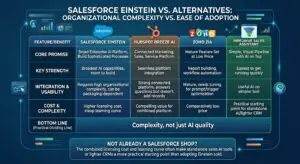
Several competitors bundle comparable AI directly into cheaper or simpler CRMs. HubSpot‘s Breeze AI is bundled into one connected marketing, sales and service platform (see our HubSpot AI vs Jasper comparison), while Zoho‘s Zia assistant builds reports and automates workflows but needs prompt and trigger tuning to get the most value. Pipedrive‘s Sales Assistant adds useful AI on top of its simpler, visual pipeline, and it tends to be the easiest of the group to get running quickly.
The practical dividing line is organizational complexity, not just AI quality. Salesforce offers the broadest enterprise AI platform and the most room to build sophisticated AI-assisted processes, but it can get expensive and packaging-dependent, while HubSpot is more compelling if you want AI across a single connected marketing, sales, and service platform, and Zoho has a mature Zia feature set at a comparatively low price.
If you’re not already a Salesforce shop, the combined licensing cost and learning curve often make standalone sales AI tools or lighter CRMs a more practical starting point than adopting Einstein cold. For a broader comparison, see our guide to the best AI sales tools for teams in 2026.
Who Should Use Salesforce Einstein
Einstein makes the most sense for mid-market to enterprise sales teams already committed to Salesforce who need AI-powered pipeline visibility and have the data hygiene and admin support to make predictive scoring reliable. Teams evaluating Salesforce from scratch primarily for its AI, without an existing investment in the platform, should weigh whether a lighter, AI-native CRM would get them to value faster and at lower cost.
Frequently Asked Questions
What is Salesforce Einstein called now?
Salesforce’s generative assistant, Einstein Copilot, was renamed and folded into Agentforce in early 2025. The Einstein name still covers predictive features such as lead scoring and forecasting, while Agentforce is Salesforce’s umbrella for AI agents and the assistant inside the CRM.
Do you have to pay for Einstein AI?
Sometimes. Basic predictive features like lead scoring and forecasting come with certain editions, typically Enterprise and above. Generative add-ons are usually sold per user, commonly in the $50 to $75 per user per month range, and Agentforce is billed by consumption or through Agentforce 1 Editions from about $550 per user per month.
How much does Salesforce cost per month?
Sales Cloud ranges from $25 per user per month (Starter Suite) and $100 (Pro Suite) up to $175 for Enterprise, $350 for Unlimited and $550 for Agentforce 1 Sales. Pro Suite and above are billed annually, and list prices rose roughly 6% in August 2025, so confirm current pricing on Salesforce’s site.
Is Salesforce AI worth it?
It can be, if you are already a Salesforce shop with clean data and admin support. Lead scoring, forecasting and activity capture tend to save time for mature teams, while messy records weaken the results. If you aren’t already on Salesforce, a lighter CRM with built-in AI is often a faster and cheaper way to get value.
Who are Salesforce Einstein’s main competitors?
Most competition comes from CRMs with built-in AI, including HubSpot (Breeze), Zoho (Zia) and Pipedrive’s Sales Assistant, plus standalone sales-AI tools. HubSpot suits teams that want AI across marketing, sales and service in one platform, and Zoho offers a mature AI feature set at a lower price.
What is Einstein AI used for?
In Salesforce, Einstein is used to score leads and opportunities, forecast revenue, log emails and meetings automatically, analyze sales calls, and draft or summarize content. Its newer agent features can also take actions on its own.