
The best AI email marketing tools in 2026 depend heavily on what you’re trying to do. Klaviyo and Omnisend lead for ecommerce, HubSpot and ActiveCampaign win for CRM-tied sequences, and Instantly dominates high-volume cold outreach. This guide breaks down which AI email marketing tool actually fits your team, budget, and workflow, based on real pricing and features rather than marketing copy.
According to DesignRush’s 2026 Email Marketing Benchmark Survey (cited in its roundup of AI email tools), 87% of marketers use at least one AI tool in their workflow. The same article also cites Statista’s estimate of roughly 392.5 billion emails sent and received every day and McKinsey’s finding that 71% of consumers expect personalized interactions from the brands they buy from.
How AI Email Marketing Tools Break Down in 2026
Table of Contents
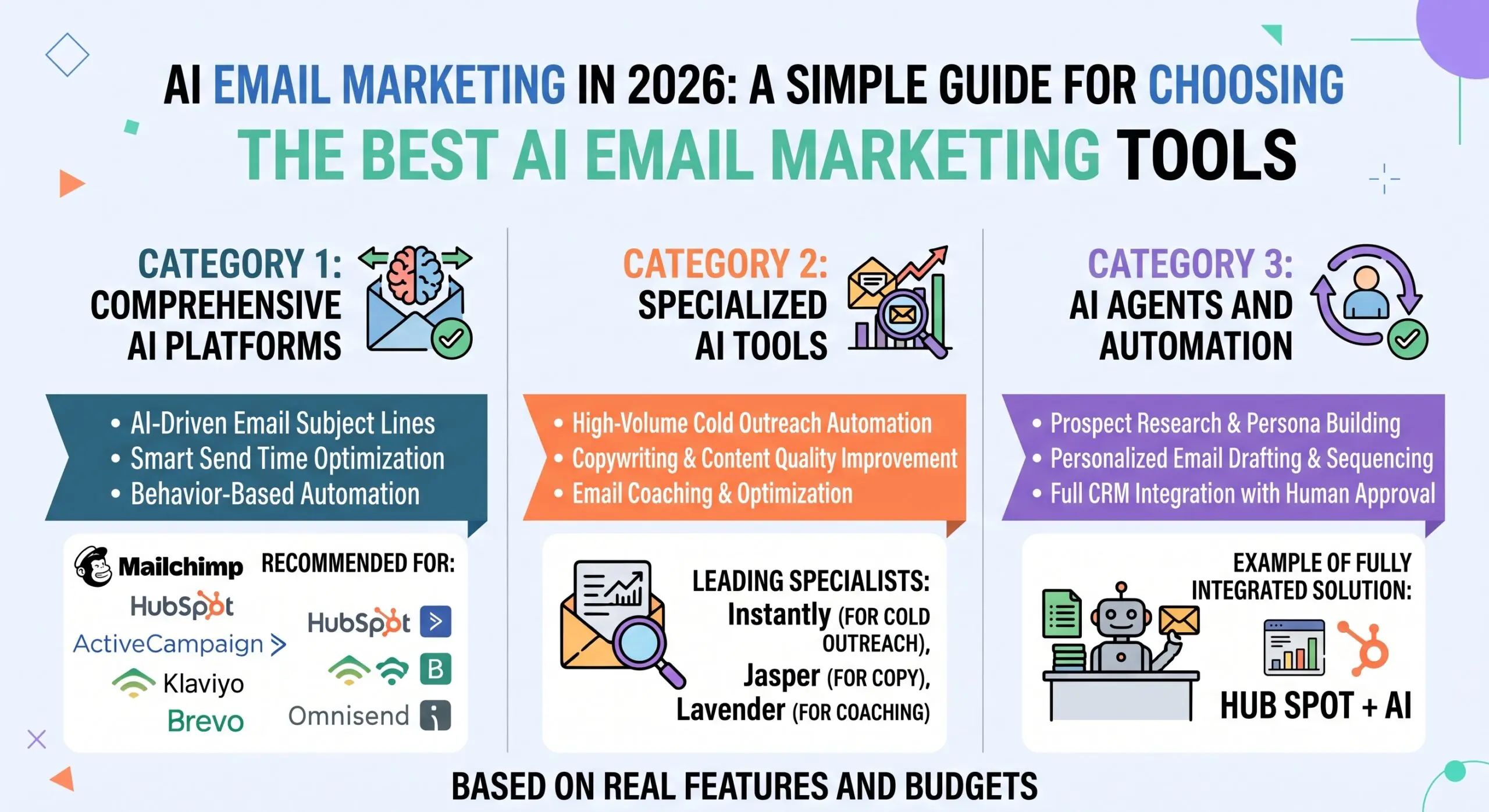
The category has split into three distinct tiers this year. Platform AI tools like Mailchimp, HubSpot, ActiveCampaign, Klaviyo, Brevo, and Omnisend add intelligence to traditional email marketing through better subject lines, smarter send times, and behavior-based automation. Specialist AI tools such as Instantly, Jasper, and Lavender excel at one dimension, whether that’s cold outreach volume, copywriting quality, or email coaching. A newer category, agentic AI, now operates across the entire workflow, researching prospects, drafting personalized emails, and connecting to CRM systems with human approval built in before anything sends.
This matters because picking the wrong category wastes money. A solo creator running a newsletter doesn’t need agentic AI. A B2B sales team drowning in manual list segmentation probably doesn’t need a Shopify-native ecommerce tool. Match the tier to the job first, then compare individual platforms.
Best AI Email Marketing Tools by Use Case
Best for Ecommerce: Klaviyo
Klaviyo is purpose-built for ecommerce, and it shows in the details. Its features, from AI subject lines to automation flows, are designed around purchase behavior, cart abandonment and customer lifetime value. The K:AI engine powers predictive metrics such as churn risk and next purchase date, and Klaviyo connects to real-time Shopify and WooCommerce event data for behavior-triggered flows. Its Composer tool, which builds flows and campaigns from a single prompt, entered public beta on June 30, 2026.
Klaviyo prices by active profiles rather than a flat rate. The free plan covers up to 250 active profiles and 500 emails a month, and paid plans start at about $20 a month for email only (251 to 500 profiles) or $35 a month with SMS. The price climbs with list size, so run your numbers through Klaviyo’s own pricing page instead of relying on a flat rate card. The trade-offs are cost at scale and a learning curve on advanced flows.
Best All-in-One for Small Teams: Omnisend
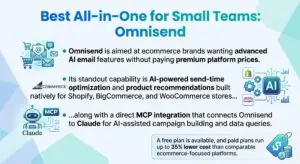
Omnisend is aimed at ecommerce brands that want advanced AI email features without enterprise-platform pricing. It combines email, SMS and push notifications with AI-assisted copy, send-time optimization and product recommendations, and it integrates natively with Shopify, BigCommerce and WooCommerce. It also offers an official MCP connector for Claude and ChatGPT, so you can build campaigns and query data from an AI assistant. There is a free plan, and paid plans start at about $11 a month for up to 500 contacts.
Best for CRM-Driven B2B Sequences: HubSpot
HubSpot connects email to CRM records and deal stages, so outreach follows the pipeline instead of running as a separate system. Marketing and sales data live in one place rather than being synced between two platforms, which makes it a common choice for B2B teams. Its Breeze agents can also draft emails and landing pages. HubSpot has a free plan, Starter starts at about $7 per seat per month (a promotional price), and Professional starts at $800 a month. For a closer look at HubSpot’s AI, see our HubSpot AI vs Jasper comparison.
Best for Automation Depth: ActiveCampaign
ActiveCampaign is built around automation depth: visual workflows that branch on customer behavior, segmentation, a built-in CRM, predictive sending on higher tiers and optional lead scoring through add-ons. Plans start at $15 a month for 1,000 contacts on annual billing ($19 month to month), with Plus starting at $49 ($59 monthly). Prices rise as your contact count grows, and there is no free plan, only a 14-day trial. The tradeoff is a steeper learning curve than simpler tools.
Best for Budget-Conscious Small Businesses: Brevo
Brevo (formerly Sendinblue) covers email, SMS, WhatsApp and transactional messages in one low-cost platform, with AI help for send-time optimization, segmentation and content. It is a reasonable pick for teams that want multichannel coverage without enterprise pricing. There is a free plan, and paid plans start at about $9 a month, though automation and reporting are limited on lower tiers.
Best for High-Volume Cold Outreach: Instantly
Instantly handles sending volume, inbox warmup and deliverability for cold email without requiring a dedicated operations hire. It is the go-to pick for SDR teams, lead gen agencies, and B2B founders running outbound campaigns at scale rather than nurturing an existing list. Outreach plans start at $47 a month (Growth).
Best for AI Copywriting: Jasper
If your bottleneck is writing compelling subject lines, body copy and calls to action rather than automation or deliverability, Jasper fills that gap. Its Brand Voice feature keeps tone consistent across variants, and its templates and agents cover welcome sequences, re-engagement campaigns and promotional emails. Jasper is a writing tool rather than an email platform, so you draft in Jasper and then paste into your email service. Pro costs $59 per seat per month billed yearly ($69 monthly), with a 7-day free trial. For a closer look, see our Jasper vs Copy.ai comparison.
Best AI Email Marketing Tools 2026: Full Comparison
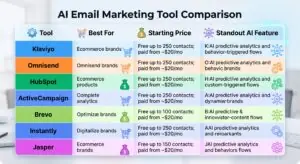
| Tool | Best For | Starting Price | Standout AI Feature |
|---|---|---|---|
| Klaviyo | Ecommerce brands | Free up to 250 profiles; paid from $20/mo | K:AI predictive analytics and behavior-triggered flows |
| Omnisend | Small ecommerce teams | Free plan; paid from about $11/mo | Product recommendations and an official Claude/ChatGPT MCP connector |
| HubSpot | CRM-integrated B2B | Free; Starter from $7/seat/mo; Professional from $800/mo | Sequences tied directly to pipeline stage |
| ActiveCampaign | Advanced automation | From $15/mo (annual billing) | Predictive sending and a visual automation builder |
| Brevo | Budget multichannel teams | Free plan; paid from about $9/mo | AI send-time optimization plus SMS and chat |
| Instantly | Cold outreach at volume | From $47/mo (Growth) | Deliverability monitoring and inbox warmup |
| Jasper | Copywriting and A/B testing | Pro from $59/seat/mo (billed yearly) | Brand Voice-trained copy generation |
What AI Actually Does in Email Marketing Right Now
The best AI email marketing tools use machine learning to automate decisions that marketers previously made manually: when to send, what to say, and who should receive each message. The software learns from how recipients interact with campaigns and adjusts its recommendations automatically, rather than requiring you to reconfigure rules after every send.
Traditional email platforms require you to set send times, write subject lines, and segment your list manually. AI tools monitor what works and what doesn’t, then surface recommendations based on patterns in your engagement data. That difference becomes significant at scale, since manual personalization breaks down quickly when you’re running campaigns across thousands of contacts with different roles, industries, and buying stages.
The larger change in 2026 is autonomy. Instead of only suggesting subject lines or send times, some tools can now build a flow from a single prompt, launch it and tune it afterward. Klaviyo’s Composer is one example. Human review is still built in, and the results depend on the quality of your customer data.
How to Choose the Right Tool for Your Business
Match the Tool to Your Primary Channel
If you run an ecommerce store, Klaviyo or Omnisend will generally serve you best because their AI models are trained on purchase behavior, not generic engagement metrics. If you need CRM-integrated marketing automation, HubSpot remains the standard for keeping sales and marketing data in sync.
Don’t Pay for Capability You Won’t Use
Not every tool in the best AI email marketing tools category does the same thing, and some solve very narrow problems well rather than trying to do everything. A tool with an “AI email builder” and an agentic outbound platform that researches prospects and drafts personalized sequences are solving different problems at very different price points. If your team also needs AI sales tools beyond email, we cover the top platforms separately, and buying the wrong one means overpaying for features that sit unused.
Check the Real Cost at Your List Size
List-based and active-profile pricing models can make sticker prices misleading. Both the active-profile model on Klaviyo and the unsubscribed-contact counting on Mailchimp mean your real bill can sit above the advertised price, so cleaning your list before you commit to a plan is worth the effort.
Frequently Asked Questions
Which AI tool is best for email marketing?
It depends on what you are trying to do. Klaviyo and Omnisend lead for ecommerce, HubSpot and ActiveCampaign suit CRM-tied and automation-heavy programs, Brevo is a low-cost multichannel option, Instantly is built for cold outreach, and Jasper is the pick when copywriting is the bottleneck. Match the tool to the job first, then compare prices at your list size.
Can I use AI for email marketing?
Yes. Most major email platforms now include AI for drafting copy, writing subject lines, choosing send times and segmenting audiences, and a few can build whole flows from a prompt. Keep a person in the loop for strategy and brand voice, and protect deliverability: Google and Yahoo expect bulk senders (5,000 or more emails a day) to use SPF, DKIM and DMARC authentication and keep spam complaints below 0.30%.
How is AI used in email marketing?
The most common uses are subject lines and content generation, send-time optimization, audience segmentation, product recommendations and behavior-triggered automation. In DesignRush’s 2026 survey, 69% of email marketers used AI for subject lines and 63% for content generation, but only 31% used it for behavioral prediction, so the more advanced uses are still catching up.
What are the top 3 email marketing tools?
There is no single answer, because the best tool depends on your business model. Among the tools covered in this guide, Klaviyo is the strongest pick for ecommerce, HubSpot suits teams that want email tied to a CRM, and ActiveCampaign suits deep automation. Smaller or budget-focused teams should also look at Brevo and Omnisend, which both have free plans.