


AI sales tools are no longer optional. According to Salesforce’s 2025 State of Sales report, 83% of sales teams using AI reported revenue growth in the past year, compared to just 66% of teams without AI. The best AI sales tool for your team depends on whether you need lead prospecting, conversation intelligence, CRM automation, or end-to-end revenue orchestration. This guide compares the leading platforms and shows you how to choose the right fit.
What Is an AI Sales Tool?
Table of Contents
AI sales tools are software platforms that use artificial intelligence to automate, accelerate, or improve parts of the sales process — from finding leads and writing emails to managing pipeline and predicting which deals will close. Unlike traditional CRM platforms that store data, AI CRM tools use artificial intelligence to automate tasks, predict outcomes, and guide sales teams toward actions that close deals. It analyzes patterns across thousands of deals to tell you which leads will convert, when to reach out, and what message will work.
The market is divided into distinct layers. These tools try to perform first-touch sales work. They can source, qualify, research, write, follow up, route, and book meetings depending on the product. This layer includes GrowthEffect, 11x, Artisan, and AiSDR. Other tools focus on data enrichment, revenue orchestration, or CRM-native AI capabilities embedded directly into Salesforce or HubSpot.
Top AI Sales Tools Comparison
| Platform | Best For | Starting Price | Key Feature |
|---|---|---|---|
| Salesforce Einstein | Enterprise teams already in Salesforce | $25/user/month add-on | Native CRM AI with predictive intelligence |
| HubSpot Breeze | Mid-market teams (5-50 reps) | Bundled with Sales Hub | Prospecting Agent that researches companies, identifies decision-makers, and drafts personalized outreach sequences |
| Apollo.io | SMB to mid-market prospecting | $49 to $119/user/month | Lead database with AI research and enrichment |
| Gong | Sales teams focused on conversation intelligence | Custom annual contracts | Call recording and AI coaching |
| Reply.io | Teams running multi-channel outreach campaigns | $59-$179/user/month | Multi-channel sequences with Jason AI |
Best AI Sales Tools by Use Case
Best for Enterprise CRM Intelligence: Salesforce Einstein
Salesforce Einstein for predictive CRM insights sits directly inside your CRM instance (read our full Salesforce Einstein review), meaning your sales team doesn’t need to learn a new interface. Agentforce is the most-asked-about AI agent of 2026, and it carries a real moat: Salesforce already owns your data and workflows. If you live inside Salesforce, the gravity is obvious.
The platform handles deal forecasting, lead scoring, and next-best-action recommendations natively within Salesforce workflows. For enterprises with complex pipelines and hundreds of sales reps, Einstein eliminates the cost and friction of integrating separate best-of-breed tools. The tradeoff: it’s most powerful for teams already deep in the Salesforce ecosystem.
Best for Mid-Market All-in-One Automation: HubSpot Breeze
HubSpot‘s Breeze AI suite — launched in late 2025 and significantly expanded in early 2026 — includes a Prospecting Agent, Customer Agent, Content Agent, and Social Media Agent. For sales specifically, the Prospecting Agent is the standout: it researches companies, identifies decision-makers, and drafts personalized outreach sequences. Breeze Prospecting Agent generated target account lists that were 70% aligned with our ICP on the first pass — impressive for an automated system.
Breeze is purpose-built for teams of 5 to 50 reps who don’t have enterprise budgets but need AI automation across prospecting, pipeline management, and customer engagement. For a closer look at how HubSpot’s AI compares to dedicated writing tools, see our HubSpot AI vs Jasper comparison. Most platforms integrate deeply with Salesforce and HubSpot, so data flows without manual syncing.
Best for Lead Prospecting and Enrichment: Apollo.io
Apollo.io for prospecting automation is the go-to platform for teams that need verified contact data combined with AI research and personalization. Apollo sits here in different ways. Apollo combines data, sales intelligence, and engagement workflows.
The platform connects SMB and mid-market teams directly to decision-makers with verified emails and phone numbers, then layers AI-powered research and personalization on top. Apollo pricing ranges from $49 to $119/user/month, making it accessible for smaller organizations building their first AI capability.
Best for Conversation Intelligence and Coaching: Gong
Gong for conversation intelligence records, transcribes, and analyzes sales calls using AI to surface coaching opportunities and deal risks. Unlike transcription-only tools, Gong’s AI understands sales-specific behaviors: objection handling, competitor mentions, customer sentiment shifts, and closing techniques.
Gong operates on annual contracts with custom pricing tied to seat count and data depth. Enterprise sales organizations use Gong to maintain rep consistency and coaching quality across dozens or hundreds of sellers.
Best for Multi-Channel Outreach: Reply.io with Jason AI
Reply.io with Jason AI leads for multi-channel sequences, enabling cold outreach across email, LinkedIn, and SMS inside a single platform. The AI handles personalization, followup logic, and response routing without manual setup.
Pricing starts at $59/user/month (email-only) to $179/user/month (multi-channel with Jason AI). This makes Reply.io cost-effective for outbound-focused teams that need automation at scale without the complexity of separate email, LinkedIn, and CRM tools.
How to Choose the Right AI Sales Tool
1. Identify Your Biggest Bottleneck
The best AI sales tools solve specific bottlenecks: lead quality, rep productivity, demo conversion, or forecast accuracy. If your problem is finding enough qualified leads, start with a prospecting tool like Apollo or HubSpot Breeze. If it’s rep productivity and deal management, prioritize a CRM-native AI like Einstein or Salesforce Agentforce. If it’s call quality and coaching, invest in Gong.
2. Evaluate Your Existing Tech Stack
Don’t pick an AI sales tool in isolation. When choosing specific sales automation tools, look for ones that offer deep AI integrations with your existing workflows. If your team lives in Salesforce, adding native AI features avoids integration debt. If you’re in HubSpot, Breeze keeps everything unified. If you’re using multiple platforms, prioritize tools with strong APIs or native integrations.
3. Test on a Subset First
The honest answer for most enterprise AI sales tools is 8 to 16 weeks from deployment to measurable impact. Don’t deploy platform-wide immediately. Run a pilot with one sales team or one use case (prospecting, coaching, or forecasting). Measure actual pipeline impact before committing budget.
4. Factor in True Cost of Ownership
List price is only part of the cost. A tool with a $150K license that requires 200 hours of internal resource time to deploy has a true first-year cost of $165K to $175K. Account for admin time, training, integrations, and data cleanup. Expect AI agent costs to range from $100/month for lightweight automations to $5,000+/month for enterprise-scale autonomous workflows.
5. Understand the Pricing Model
Pricing ranges from free tiers for basic features to custom enterprise contracts for full platforms. Some platforms charge per seat (HubSpot, Salesforce), others by usage (ZoomInfo), and others by action or API call (Zapier, Clay). AI agent pricing is still emerging and varies significantly by platform and use case. Traditional automation tools charge per seat or contact, while agentic platforms charge per action, token, or execution.
6. Measure ROI at the Pipeline Level
Any AI sales software ROI calculation should weigh time saved and pipeline lift, not sticker price alone. A tool that costs $500/month but generates an extra $50,000 in qualified pipeline is obviously worth it. Focus on metrics like deal velocity, win rate, average contract value, and conversion rate from lead to opportunity, not just feature count.
Key Features to Prioritize
- Lead Scoring and Qualification: Predicting deal outcomes. Prioritizing leads or identifying churn risk and acting on it.
- Conversation Intelligence: Summarize long email threads, transcribe calls, and flag deal risks or “next-best-action” recommendations.
- Predictive Analytics: Tools that offer deep AI integrations with your existing workflows. This might mean opting for tools with predictive analytics so that you can keep a close eye on deal statuses.
- AI-Powered Outreach: An AI writing assistant that generates email sequences, follow-up messages, and outreach templates based on deal context.
- Native CRM Integration: Avoid tools that require constant API maintenance. Prioritize platforms that work natively inside your existing CRM
Real-World Outcomes
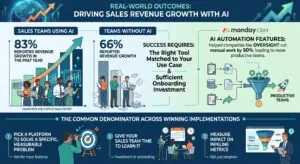
According to Salesforce’s 2025 State of Sales report, 83% of sales teams using AI reported revenue growth in the past year, compared to just 66% of teams without AI. However, success requires the right tool matched to your use case and sufficient onboarding investment. monday CRM’s AI automation features have helped companies like Oversight cut manual work by 50%, leading to more productive teams that get more done with less effort.
The common denominator across the best AI sales tools implementations: teams that pick a platform to solve a specific, measurable problem (not the most features), give their sales team time to learn it, and measure impact on pipeline metrics, not just adoption.
Frequently Asked Questions
What is the difference between AI sales tools and traditional CRMs?
Traditional CRMs like Salesforce or HubSpot store customer data and track activities. Traditional CRMs track what happened. AI CRMs use predictive intelligence to forecast what happens next and tell you what to do about it. AI sales tools add autonomous agents, predictive scoring, and intelligent recommendations on top of CRM data.
How much does an AI sales tool cost?
Pricing for the best AI sales tools varies by category. Some platforms publish pricing publicly (Apollo $49 to $119/user/mo, HubSpot $15 to $150/user/mo, Salesforce $25 to $300/user/mo, Cognism $12,750 to $17,000/year). ZoomInfo is free to start with consumption credits based on usage, scaling with the volume your team actually runs through the platform.
Do I need a separate AI sales tool or can I use my CRM’s built-in AI?
These tools are strongest when the CRM is already the operating system. HubSpot Sales Hub and Salesforce Agentforce Sales are examples. They can be powerful because they sit close to customer data, lead records, owners, workflows, and reporting. If your CRM data is clean and your workflows are stable, native AI features may be sufficient. If you need specialized capabilities (conversation intelligence, advanced prospecting), a best-of-breed tool is worth the integration effort.
How long does it take to see ROI from an AI sales tool?
The honest answer for most enterprise AI sales tools is 8 to 16 weeks from deployment to measurable impact. Some quick wins (like email open rates) appear immediately, but meaningful pipeline changes take time. Start small with a pilot team to validate results before scaling.
Can AI sales tools replace human sales reps?
These tools work best as assistants. They take care of repetitive work so sales reps can focus on understanding customer needs, building trust, and closing deals. AI handles lead research, initial outreach, meeting scheduling, and data entry. If your team also needs AI-powered email campaigns, check out our guide to the best AI email marketing tools in 2026. Reps handle relationship-building, complex negotiation, and closing.
What is the most important thing to look for in an AI sales tool?
Start by asking: What exactly will this agent do for us — and how is it autonomous, not just automated? Focus on how well the solution supports the outcomes your sales org cares about. Avoid tools that simply add dashboards or features your team won’t use. Pick a platform that solves one critical problem in your sales process.
Ready to pick your first AI sales tool? Start by listing your team’s three biggest pain points in the sales process. Then map each pain point to the relevant tool category: prospecting (Apollo, Sai by Simular), conversation intelligence (Gong), CRM automation (Salesforce Einstein, HubSpot), or revenue orchestration (Outreach, Salesloft). Run a 30-day pilot with the top choice, measure pipeline impact, and scale only if the data supports it.