AI Future & Analysis: What the Evidence Actually Shows
A technical, grounded breakdown of where artificial intelligence is heading — without the hype.
Artificial intelligence has moved from academic abstraction to operational infrastructure inside a single decade. Understanding the AI future & analysis landscape now requires cutting through competing narratives — techno-optimism, doomsday framing, and financial spin — and focusing on what the technical trajectory, economic data, and institutional adoption actually reveal.
This article covers the four dominant AI future scenarios, real-world applications shaping each one, the top AI investment opportunities researchers and analysts track, and the honest limitations that remain unsolved.
Quick Answer — Featured Snippet
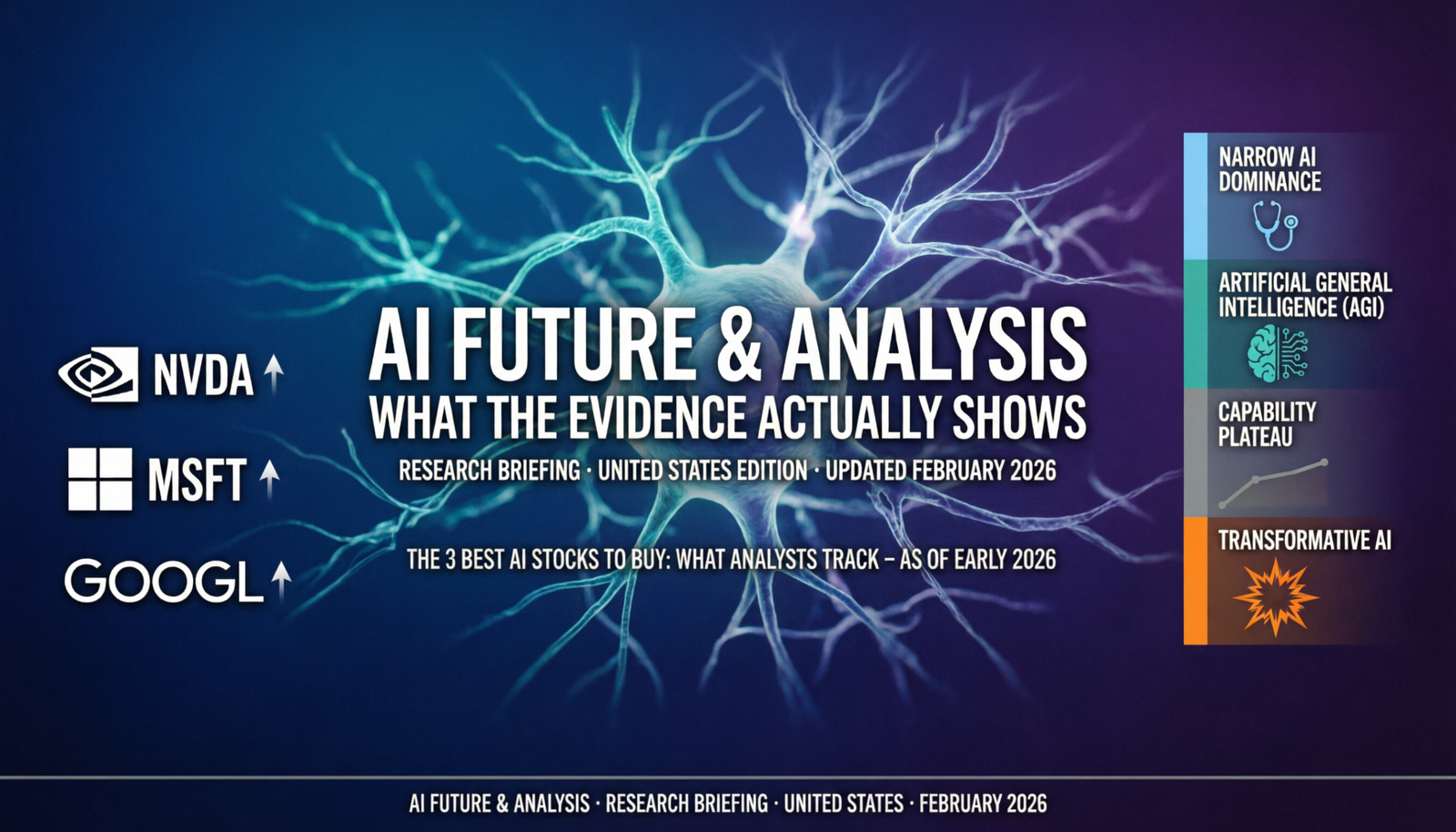
The future of AI spans four primary scenarios: narrow AI becoming increasingly embedded in critical systems, the emergence of general-purpose AI, a prolonged plateau in capability growth, and transformative AI that reorganizes entire industries. Current evidence supports the first two as the most likely near-term trajectories, driven by large language model scaling and multi-modal architectures.
What AI Future Analysis Actually Covers
AI future analysis is not forecasting. It is structured scenario planning that examines capability trajectories, resource constraints (compute, energy, talent), geopolitical dynamics, and adoption rates across sectors. Researchers typically work across three time horizons: near-term (1–3 years), medium-term (3–10 years), and speculative long-term (10+ years).
The near-term is largely settled — narrow, task-specific AI continues to expand. Medium and long-term projections diverge significantly, which is why the four futures framework provides useful analytical scaffolding.
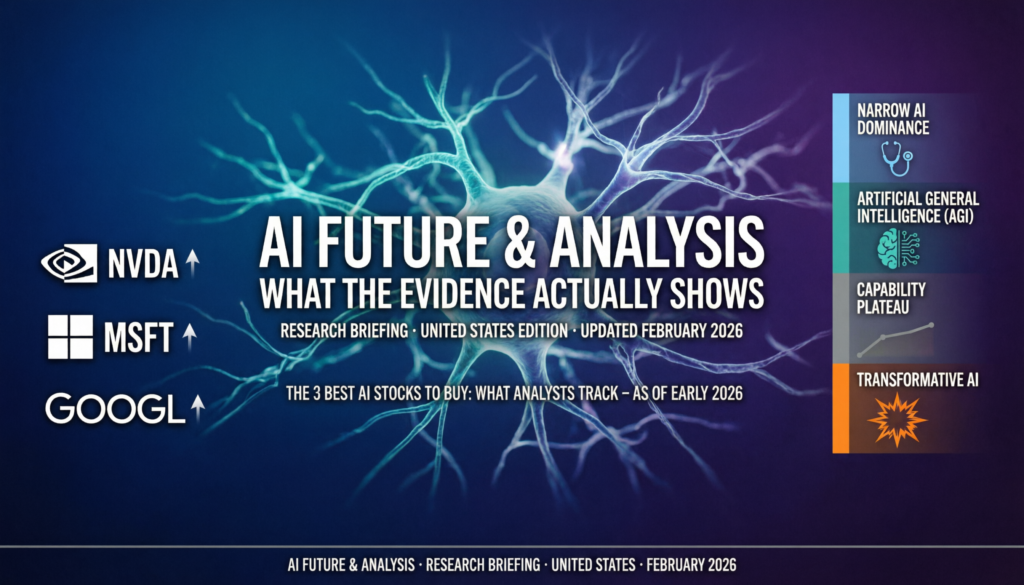
The 4 Futures of AI
The four AI futures framework emerged from research at institutions including Oxford’s Future of Humanity Institute and Stanford’s Human-Centered AI group. Each scenario represents a distinct combination of capability advancement and societal response.
1. Narrow AI Dominance
AI remains highly specialized. Systems excel at defined tasks — medical imaging, code generation, logistics — but require human oversight and cannot generalize across domains.
2. Artificial General Intelligence (AGI)
AI systems match or exceed human cognitive performance across most intellectual domains. No verified AGI exists. Timelines from leading researchers range from 5 to 50+ years.
3. Capability Plateau
Scaling laws hit diminishing returns. Current architectures stagnate without fundamental research breakthroughs. Progress slows but existing tools remain deeply embedded.
4. Transformative AI
AI accelerates scientific discovery at a pace that reshapes healthcare, energy, and manufacturing within a decade. This requires both capability gains and successful real-world deployment at scale.
Current evidence most strongly supports Future 1 continuing for 3–7 years while research into Future 2 accelerates — not a binary choice, but overlapping trajectories.
How Modern AI Systems Work
The Foundation: Large Language Models
Today’s most capable AI systems are transformer-based neural networks trained on massive text datasets. The transformer architecture, introduced in 2017, processes entire sequences simultaneously using attention mechanisms — identifying relationships between tokens regardless of their distance in the input.
Scaling these models (more parameters, more compute, more data) has produced emergent capabilities that were not explicitly trained for: multi-step reasoning, code generation, and in-context learning. This is the core empirical observation driving investment and research intensity.
Multi-Modal Systems
Current frontier systems combine text, image, audio, and code in a single architecture. This matters practically: a model that reads a radiology image and a patient’s written history simultaneously outperforms a model handling each separately.
Reinforcement Learning from Human Feedback (RLHF)
Raw language model outputs are shaped by human preference data through RLHF. Human raters compare model responses; those preferences train a reward model; the language model is then fine-tuned to maximize that reward. This is why modern AI assistants follow instructions reliably rather than generating statistically plausible but unhelpful text.
Real-World Applications (2025–2026)
Healthcare & Drug Discovery
AlphaFold 3 (DeepMind) predicts protein structures across biological molecules with accuracy that previously required years of laboratory work. Pharmaceutical firms are using it to reduce early-stage drug discovery timelines from 5+ years to 12–18 months in select cases.
Software Engineering
AI coding tools now handle meaningful portions of production code at major technology companies. The productivity gains are real but uneven — they are largest for experienced developers working on well-defined tasks, not junior developers learning to code.
Energy Grid Optimization
DeepMind’s work with Google’s data centers achieved a 40% reduction in cooling energy use using reinforcement learning. The same approach is being adapted for power grid load balancing.
Legal and Financial Analysis
Contract review, due diligence, and regulatory compliance workflows are the highest-adoption enterprise use cases in 2025. Error rates remain too high for autonomous deployment — these tools augment, not replace, professional judgment.
Benefits vs. Limitations
| Dimension | Benefit | Limitation |
|---|---|---|
| Accuracy | Superhuman performance on specific benchmarks (radiology, protein folding, game-playing) | Hallucinations remain a structural problem — confident incorrect outputs with no reliable self-detection |
| Speed | Processes information at machine scale; analyzes thousands of documents in seconds | Inference costs are substantial at scale; latency is a constraint for real-time applications |
| Generalization | Single model handles diverse tasks across domains | Performance degrades sharply outside training distribution; poor robustness to novel edge cases |
| Scalability | Capability improves predictably with more compute and data | Energy and hardware requirements are growing faster than efficiency improvements |
| Interpretability | Attention visualization provides limited insight into model reasoning | No reliable method to verify why a model produces a specific output — a critical gap for regulated industries |
| Economic Value | Measurable productivity gains in code, writing, and data analysis | ROI varies widely by use case; many enterprise deployments remain in pilot phase |
The 3 Best AI Stocks to Buy: What Analysts Track
This section reflects publicly available analyst consensus data as of early 2026. It is not financial advice. Consult a licensed financial advisor before making investment decisions.
1. NVIDIA (NVDA)
NVIDIA’s H100 and Blackwell GPU architectures are the primary compute infrastructure for AI training globally. Its market position is not just hardware — the CUDA software ecosystem creates deep lock-in. The core risk: demand concentration means any slowdown in AI investment hits NVIDIA first and hardest.
2. Microsoft (MSFT)
Microsoft’s investment in OpenAI gives it exclusive access to frontier models for commercial deployment through Azure. GitHub Copilot and Microsoft 365 Copilot represent the most widely deployed enterprise AI products. Revenue from AI features is now measurable across its cloud and productivity segments.
3. Alphabet / Google (GOOGL)
Google controls critical AI infrastructure: TPU chips, the world’s largest proprietary training dataset (Search), and DeepMind’s research output. The strategic risk is that generative AI disrupts the search advertising model that funds Google’s AI investment — an unusual position where the company must cannibalize its own revenue stream to remain competitive.
Pure-play AI infrastructure picks (NVDA) carry higher volatility. Diversified technology companies (MSFT, GOOGL) offer AI exposure with lower single-point-of-failure risk.
Common Misconceptions
“AI understands language the way humans do”
Current language models are statistical pattern matchers over token sequences. They produce contextually coherent outputs without any verified symbolic understanding, grounded world model, or genuine semantic comprehension. This is not a philosophical question — it has concrete engineering implications for reliability.
“Bigger models always perform better”
Scaling laws hold within architectural families, but smaller, efficiently fine-tuned models routinely outperform larger general models on specific tasks. The industry has shifted toward mixture-of-experts architectures and retrieval-augmented generation precisely because raw scale is not always the most efficient lever.
“AI will replace all knowledge workers”
Historical evidence from automation suggests technology displaces specific tasks, not entire occupations. AI handles well-defined, information-dense subtasks effectively. Roles requiring judgment under uncertainty, relationship management, and novel problem-framing have shown minimal displacement. The occupational mix shifts; total employment in knowledge work has not collapsed.
Practical Implementation: A Step-by-Step Approach for Businesses
- Audit current workflows — Identify tasks that are repetitive, data-intensive, and have clear success criteria. These are highest-value AI candidates.
- Select the right model tier — API-accessible frontier models (GPT-4o, Claude, Gemini) for complex reasoning; smaller open-source models (Llama 3, Mistral) for high-volume, lower-complexity tasks where data privacy matters.
- Build a retrieval layer — Most enterprise AI failures stem from the model lacking current, domain-specific information. Implement RAG (Retrieval-Augmented Generation) before fine-tuning.
- Establish evaluation benchmarks — Define measurable success metrics before deployment. Error rate, task completion rate, and time-per-task are standard baselines.
- Deploy with human-in-the-loop oversight — For any decision with meaningful downstream consequences (hiring, credit, clinical), maintain human review. Regulation in these areas is tightening globally.
- Iterate based on failure analysis — Log and categorize model errors systematically. Most AI underperformance traces to prompt design and context gaps, not model capability limits.
Future Implications: What the Next 5 Years Likely Hold
Compute costs will continue declining on a per-FLOP basis, making currently expensive AI applications commercially viable for smaller organizations. This is the clearest near-term trend, with strong historical precedent from semiconductor economics.
AI agents — systems that take multi-step actions in the real world, not just generate text — represent the next significant capability threshold. Early implementations in software engineering and research assistance are already deployed. Reliability at scale is the unsolved problem.
Regulatory frameworks will fragment by jurisdiction. The EU AI Act is in enforcement. US federal regulation remains sector-specific. China’s AI governance focuses on content control. Businesses operating across borders will face compliance complexity that rivals GDPR-era data privacy challenges.
The interpretability gap is the most consequential long-term constraint. Without reliable methods to verify AI reasoning, deployment in high-stakes domains — judicial, clinical, financial — will remain limited regardless of raw capability.
Frequently Asked Questions
What are the 4 futures of AI?
The four futures of AI are: (1) Narrow AI Dominance — specialized systems embedded across industries without general intelligence; (2) Artificial General Intelligence — systems matching human cognitive ability across domains; (3) Capability Plateau — stagnation due to architectural or resource limits; and (4) Transformative AI — rapid scientific and economic restructuring driven by breakthrough applications. Most researchers expect trajectories 1 and 2 to overlap within the next decade.
What are the 3 best AI stocks to buy?
Based on analyst consensus and AI revenue exposure as of 2026: NVIDIA (NVDA) for GPU infrastructure dominance; Microsoft (MSFT) for enterprise AI deployment through Azure and OpenAI partnership; and Alphabet (GOOGL) for deep AI integration across Search, Cloud, and DeepMind research. All three carry different risk profiles — NVDA is highest risk/reward, MSFT and GOOGL offer broader diversification. This is not financial advice.
How close are we to Artificial General Intelligence?
No scientific consensus exists on AGI timelines. Survey data from AI researchers shows estimates ranging from under 10 years to over 100 years, with significant disagreement on whether current architectures can reach AGI at all. OpenAI and Anthropic use different internal definitions of AGI, making external comparison difficult. The honest answer: current systems demonstrate specific impressive capabilities but lack the generalizable reasoning that defines AGI.
What industries will AI disrupt first?
Software development, legal document review, financial analysis, radiology, and customer support are already experiencing measurable AI-driven productivity shifts. Drug discovery and materials science are next in terms of research investment and early deployments. Physical-world industries (manufacturing, construction, logistics) face greater implementation barriers due to hardware and safety requirements — expect a 5–10 year lag behind purely digital sectors.
What are the biggest unsolved problems in AI right now?
The three most consequential open problems are: (1) Hallucination — models generate confident incorrect outputs with no reliable self-detection mechanism; (2) Interpretability — we cannot reliably explain why a model produces a specific output; (3) Robustness — model performance degrades sharply on inputs that differ from training distribution in ways that are hard to anticipate. Each blocks deployment in regulated, high-stakes domains.